
Are Oil Shipping Companies Bullish or Bearish?

by Fred Fuld III

The escalating conflict in the Middle East, particularly the military strikes involving the U.S., Israel, and Iran in early 2026, has sent shockwaves through the global energy and maritime sectors. With the Strait of Hormuz—a chokepoint for 20% of global oil—experiencing a 95% drop in traffic, the “oil-shipping nexus” is undergoing its most significant disruption since the 1970s.

The Geopolitical Squeeze: Oil and Freight Rates

Since the conflict escalated on February 28, 2026, Brent Crude surged past $100 per barrel, briefly peaking near $120in mid-March. This spike is a direct result of Iranian strikes on energy infrastructure and the subsequent maritime blockade in the Persian Gulf.

For shipping companies, the situation is a double-edged sword:

  • The Bull Case: Rerouting vessels around the Cape of Good Hope has increased “ton-mile” demand. Suezmax tanker rates have reportedly hit staggering peaks of $400,000 to $500,000 per day as available capacity shrivels.
  • The Bear Case: Rising bunker fuel costs (the single largest expense for carriers) and “risk-off” sentiment in the broader stock market have tempered gains. Investors are weighing massive spot-rate windfalls against the threat of a global recession.

Marine Shipping Stock Profiles

While the sector is volatile, certain companies are positioned to navigate—or even profit from—this turbulence. Below are the profiles and financial standings of four key players as of late March 2026.

1. Costamare Inc. (CMRE)

Costamare is a leading owner of containerships and dry bulk vessels. Unlike pure tanker plays, Costamare relies on long-term charters, providing a “buffer” against immediate spot market volatility.

  • Profile: Headquartered in Monaco, it operates a fleet of 68 containerships and over 40 dry bulk vessels.
  • Financial Snapshot (TTM):
    • Stock Price: ~$16.79 (Down 2% in the last month; up 121% over 1 year).
    • Market Cap: $2.02 Billion.
    • Revenue: $1.09 Billion.
    • Net Income Margin: 33.3%.
    • Dividend Yield: 2.74%.
  • Current Outlook: Analysts maintain a Hold rating. While its revenue backlog is a solid $2.4 billion, a weaker dry bulk market has offset some of the gains seen in its container segment.

2. Danaos Corporation (DAC)

Danaos is one of the world’s largest independent owners of modern, large-size containerships, primarily chartering to giants like Maersk and MSC.

  • Profile: Based in Greece, Danaos focuses on high-efficiency vessels and has a significant presence in the trans-Pacific and Asia-Europe lanes.
  • Financial Snapshot (TTM):
    • Stock Price: ~$111.44 (Up 155% over 5 years).
    • Market Cap: $2.03 Billion.
    • P/E Ratio: 4.17 (Indicates the stock may be undervalued).
    • Net Margin: 47.4%.
    • Dividend: $3.50 (Yielding ~3.1%).
  • Current Outlook: Rated as a Buy by several analysts. Its massive cash reserves ($1.04B) and low debt-to-equity ratio (30.4%) make it a favorite for “flight-to-quality” investors during regional instability.

3. Hafnia Limited (HAFN)

Hafnia is a top-tier operator of product tankers, transporting refined oil, chemicals, and gas. It is the company most directly impacted by the Hormuz crisis.

  • Profile: Operates a fleet of approximately 200 vessels. It provides a fully integrated platform, including technical and pool management.
  • Financial Snapshot (TTM):
    • Stock Price: ~$7.00 (Reached an all-time high of $7.68 in early March).
    • Market Cap: $3.60 Billion.
    • P/E Ratio: 10.57.
    • Quarterly Dividend: $0.176 (Variable based on payout policy).
  • Current Outlook: Hafnia is currently in a “Paradox Zone.” While spot rates are at historic highs, the stock has seen “risk-off” selling as investors fear a prolonged blockade could eventually stifle total trade volume.

4. Matson, Inc. (MATX)

Matson is a specialized ocean carrier primarily serving Hawaii, Alaska, and Guam, with a high-speed service from China to Long Beach.

  • Profile: Unlike the others, Matson is a U.S.-based Jones Act carrier. This insulates it from some international legal risks but makes it sensitive to U.S. domestic fuel prices.
  • Financial Snapshot (TTM):
    • Stock Price: ~$163.16 (Near its 52-week high of $177.51).
    • Market Cap: $3.83 Billion.
    • EPS (2026 Est.): $13.33.
    • P/E Ratio: 12.00.
  • Current Outlook: Matson has a Strong Buy consensus. Its “China Expedited” service is becoming more valuable as traditional shipping lanes through the Middle East face delays, allowing Matson to command premium pricing.

Just remember, the price of oil can turn on a dime. Anything can happen in the Middle East, good or bad.

Disclosure: Author didn’t own any of the above at the time the article was written. No investment recommendations are expressed or implied.

Powering Profits: Why Falling Oil Prices Could Boost Hawaiian Electric and ConEd

by Fred Fuld III

The relationship between geopolitical stability and utility stock performance might seem abstract, but for companies heavily dependent on fossil fuels, it is anything but. The current conflict in the Middle East has injected significant volatility into global oil markets, driving up the cost of crude.

However, for forward-looking investors, the focus is already shifting to the aftermath. When the war wraps up and the geopolitical risk premium evaporates, oil prices are likely to retreat from their current highs. This scenario creates a powerful tailwind for a specific subset of the utility sector, most notably Hawaiian Electric Industries (NYSE: HE)and Consolidated Edison (NYSE: ED), ultimately providing a boost to their stock prices.

To understand why, we must examine how these two distinct utilities utilize oil and why lower prices are a significant operational benefit.


The Unique Case of Hawaiian Electric: Ground Zero for Oil Sensitivity

Hawaiian Electric Industries (HE) is perhaps the most oil-sensitive publicly traded utility in the United States. Due to Hawaii’s geographical isolation, the islands have historically been unable to access the mainland’s vast interstate natural gas pipelines or large-scale hydroelectric resources.

Consequently, HE has relied on imported petroleum—primarily fuel oil—for the vast majority of its electricity generation. This dependency means that HE’s operational costs are directly coupled to the global price of crude oil.

The Benefit of Falling Prices:

When oil prices drop, HE receives an immediate and substantial benefit:

  1. Lower Generation Costs: The primary advantage is a dramatic reduction in the cost of producing electricity. As fuel is the largest variable expense for an oil-fired plant, cheaper crude directly lowers the bottom line cost of generation.
  2. Increased Affordability and Demand Stability: Hawaii already has some of the highest electricity rates in the nation. When oil prices are high, these costs are passed on to consumers via fuel adjustment clauses, straining household and business budgets. Lower oil prices allow HE to reduce these adjustments, making electricity more affordable and stabilizing demand, particularly in crucial sectors like tourism.+1
  3. Improved Cash Flow for Transition: While HE is actively transitioning to renewable energy (with a 100% renewable mandate by 2045), maintaining its existing oil infrastructure is expensive. Lower oil prices improve the company’s free cash flow in the near term, providing more capital to invest in the solar, wind, and storage projects necessary to meet its long-term goals.

The Bottom Line for HE Stock: For investors, a sustainable drop in oil prices transforms HE from a utility struggling with high input costs into one with expanding margins and improved financial flexibility. This shift in sentiment is typically reflected in a higher stock valuation.


Consolidated Edison: Dual-Fuel Capabilities as a Strategic Advantage

Consolidated Edison (ConEd), serving New York City and Westchester County, has a very different profile than Hawaiian Electric. It is a massive urban utility that primarily relies on natural gas, nuclear power, and increasingly, renewables. However, ConEd has a strategic asset that makes it sensitive to oil prices: its dual-fuel capability.

ConEd maintains several large “peaker” plants that can generate electricity using either natural gas or fuel oil. These plants are called into action only during periods of extreme electricity demand (such as heat waves or severe cold snaps) or when natural gas supplies are constrained.

The Benefit of Falling Prices:

A drop in oil prices benefits ConEd primarily through enhanced operational flexibility and cost optimization:

  1. Economic Fuel Switching: When oil prices fall relative to natural gas, ConEd can strategically switch its dual-fuel plants to run on cheaper oil. This allows the utility to choose the most cost-effective fuel source, optimizing its dispatch stack and lowering its overall cost of energy production during peak periods.
  2. Mitigating Gas Price Volatility: Natural gas prices can be highly volatile, especially in the winter when demand for home heating competes with electricity generation. Cheap oil provides an economic “ceiling” for fuel costs. If natural gas prices spike, ConEd has the secure, lower-cost alternative of fuel oil readily available.
  3. Enhanced Reliability at Lower Cost: The ability to use oil ensures that ConEd can meet critical peak demand without being forced to purchase natural gas at exorbitant spot market prices. This enhances the reliability of the grid in New York City while keeping costs manageable, a factor that is looked upon favorably by regulators and investors alike.

The Bottom Line for ED Stock: While oil is a smaller percentage of ConEd’s total energy mix, the strategic use of dual-fuel plants makes cheap oil a distinct advantage. Lower oil prices improve operational efficiency and protect the company from extreme natural gas price spikes, making ED’s earnings more predictable and attractive to defensive investors.


The Market View: A Catalyst for Revaluation

The utility sector is traditionally seen as a “safe haven” for investors seeking stable income and low volatility. However, when specific utilities like Hawaiian Electric and ConEd face high, volatile input costs like oil, that safe-haven status can be compromised.

A post-war environment characterized by falling oil prices acts as a significant catalyst for these companies. It directly improves their near-term financial performance, reduces operational risk, and allows management to focus capital on long-term growth and transition strategies rather than high fuel bills.

For investors who anticipate the cessation of Middle East conflict, positioning in HE and ED stocks now provides an opportunity to capture the upside of a widely anticipated economic normalization: the return of cheap, stable oil prices.


Disclaimer: This article is for informational purposes only and does not constitute financial advice. Author didn’t own any of the above at the time the article was written.

Drilling for Oil Drilling Stocks

by Fred Fuld III

Reading time: 4 minutes

The oil and gas industry has experienced significant fluctuations in recent years, influenced by various factors such as geopolitical tensions, fluctuating demand, and the rise of renewable energy. Despite these challenges, oil and gas remain crucial components of the global energy mix, particularly for emerging economies.

Global oil demand is projected to remain robust, driven by factors like increasing population and industrialization in developing nations. Additionally, the Organization of the Petroleum Exporting Countries (OPEC) and other major producers have shown a commitment to maintaining price stability, which can benefit oil drilling companies.

Technological advancements, such as hydraulic fracturing and horizontal drilling, have unlocked new reserves and improved production efficiency. Deep-sea exploration and production capabilities continue to evolve, expanding the potential resource base.

Many oil drilling companies offer substantial dividend yields and share buyback programs, which can enhance shareholder value.

While the oil and gas industry is inherently volatile, subject to fluctuations in commodity prices and geopolitical events, there are also significant risks associated with environmental concerns and the long-term transition to renewable energy sources.

For investors considering oil drilling stocks, it is essential to carefully evaluate the risks and rewards. Major drilling companies, oilfield service providers, and independent oil and gas producers are key players in the industry.

Helmerich & Payne (HP):

Helmerich & Payne is a leading provider of drilling solutions and technologies. The company operates a fleet of advanced drilling rigs, primarily focused on the North American market. HP’s strong focus on technological innovation and operational efficiency has positioned it as a key player in the oil and gas industry.

The stock trades at 11 times trailing earnings and 10 times forward earnings. The stock has a dividend estimate for the current fiscal year at 4.0%.

Noble Corp. (NE):

Noble Corp. is a global offshore drilling contractor, operating a fleet of high-specification drillships and semisubmersible rigs. The company serves a diverse customer base, including major international oil and gas companies. Noble Corp. is known for its commitment to safety, environmental responsibility, and operational excellence.

The stock has a trailing and forward price to earnings ratio of 10, and earnings per share are expected to grow by 14% next year. Noble pays a dividend yield of 5.1%

Patterson-UTI (PTEN):

Patterson-UTI is a leading land drilling contractor, providing drilling services to oil and gas exploration and production companies in the United States. The company operates a fleet of high-performance drilling rigs and offers a range of complementary services, including pressure pumping and rental tools. PTEN’s strong focus on customer service and operational efficiency has contributed to its success.

The company has been generating negative earnings, and has a sky high forward PE ratio of 283. The stock’s yield is 3.7%.

Sable Offshore (SOC):

Sable Offshore is a relatively smaller player in the offshore drilling industry, specializing in providing services to the Brazilian offshore market. The company operates a fleet of modern drilling rigs and has a strong track record of delivering safe and efficient drilling operations.

The stock has been generating negative earnings but has a forward PE of 10. The company does not pay a dividend.

Why Invest in Oil Drilling Stocks?

  1. Strong Demand and Price Stability:
    • Global Demand: Despite the growth of renewable energy, global oil demand is projected to remain robust, driven by factors like increasing population and industrialization in developing nations.
    • Price Stability: The Organization of the Petroleum Exporting Countries (OPEC) and other major producers have shown a commitment to maintaining price stability, which can benefit oil drilling companies.   
  2. Technological Advancements:
    • Enhanced Recovery Techniques: Innovative technologies like hydraulic fracturing and horizontal drilling have unlocked new reserves and improved production efficiency.   
    • Offshore Exploration: Deep-sea exploration and production capabilities continue to evolve, expanding the potential resource base.
  3. Dividends and Share Buybacks:
    • Attractive Returns: Many oil drilling companies offer substantial dividend yields and share buyback programs, which can enhance shareholder value.   

Potential Risks and Considerations:

  • Volatility: The oil and gas industry is inherently volatile, subject to fluctuations in commodity prices and geopolitical events.   
  • Environmental Concerns: Growing environmental awareness and stricter regulations can impact operations and costs.
  • Transition to Renewable Energy: Long-term, the transition to renewable energy sources could reduce demand for fossil fuels.

In conclusion, while the future of the oil and gas industry is evolving, there remains a strong case for investing in oil drilling stocks, particularly for investors with a long-term perspective.

Disclosure: Author didn’t own any of the above at the time the article was written.

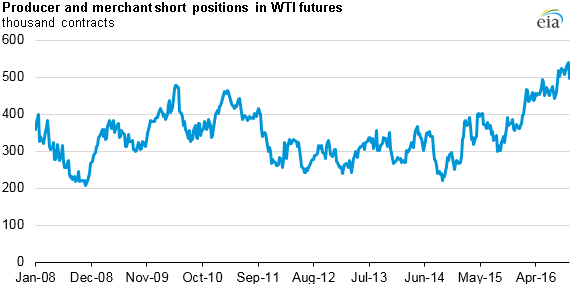
Short positions in U.S. crude oil futures at nine-year high

graph of producer and merchant positions on WTI futures, as explained in the article text

Source: U.S. Energy Information Administration, based on U.S. Commodity Futures Trading Commission and Bloomberg

Short positions in West Texas Intermediate (WTI) crude oil futures contracts held by producers or merchants totaled more than 540,000 contracts as of October 11, 2016, the most since 2007, according to data from the U.S. Commodity Futures Trading Commission (CFTC). Banks have tightened lending standards for some energy companies as crude oil prices declined throughout 2014 and 2015, and some banks require producers to hedge against future price risk as a condition for lending.

Initiating a short position, or selling a futures contract, allows the holder to lock in a future price for a commodity today, which oil producers and end users can use as a way to hedge or mitigate price risk. Increased short positions may indicate that current futures prices are seen as sufficient to generate positive returns from drilling projects.

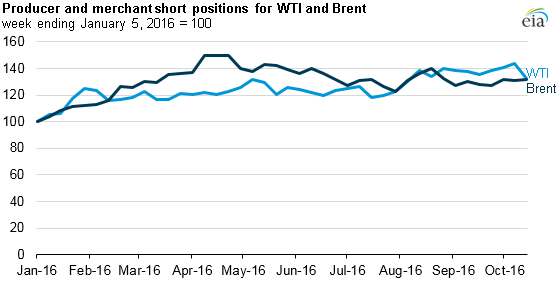
Short positions of WTI futures increased at a faster pace than futures contracts of Brent (an international crude oil benchmark) since summer 2016, suggesting U.S. producers are able to drill for oil profitably in the $50 per barrel range. In the Crude Oil Markets Review section of the October Short-Term Energy Outlook (STEO), the U.S. Energy Information Administration (EIA) discusses an increase in U.S. onshore producers’ capital expenditures that is contributing to rising drilling activity, which EIA projects will lead to an increase in U.S. onshore production by the second quarter of 2017.

graph of producer and merchant short positions on WTI and Brent, as explained in the article text

Source: U.S. Energy Information Administration, based on U.S. Commodity Futures Trading Commission, Intercontinental Exchange, and Bloomberg

The CFTC releases data on the number of long and short positions held by various groups in its weekly Commitments of Traders report. The category of producers, merchants, processors, and users represents futures contracts held by commercial businesses that trade the physical commodity. Although a producer can physically deliver crude oil into Cushing, Oklahoma, to settle its futures contract obligation, most producers settle the contract through cash settlement. This involves purchasing back the short positions the producer entered. Other traders in this category may include refiners or other end users that typically enter into long positions.

Provided by U.S. Energy Information Administration