by Fred Fuld III
Humanoid robots have moved rapidly from science fiction into the real world. Robots that can walk on two legs, manipulate objects with human-like hands, climb stairs, perform physical tasks and interact with people are now being developed by some of the world’s most innovative technology companies.
For investors, however, there is a major problem: there are still very few pure-play publicly traded humanoid-robot companies. Many of the best-known developers—including Figure AI, Apptronik and 1X—remain privately held, while companies such as Tesla (TSLA), Amazon (AMZN) and Hyundai have humanoid-robot programs that represent only a portion of much larger businesses.
One company stands out because it has already reached the public markets: Unitree Robotics, officially Hangzhou Yushu Technology Co., Ltd. Although Unitree is now publicly traded, U.S. investors cannot simply purchase its shares on the NYSE or Nasdaq. The company is listed in China on the Shanghai Stock Exchange’s STAR Market under the ticker 688836.
Unitree Robotics: A Pioneer in Low-Cost Robots
Unitree Robotics is one of the most important companies in the emerging humanoid-robot industry. The Hangzhou, China-based company was founded in 2016 by Wang Xingxing, who serves as its founder, CEO and CTO.
Wang’s interest in robotics began before Unitree existed. While studying engineering, he developed a quadruped robot called XDog. The project attracted attention within the robotics community and eventually helped provide the foundation for Unitree. After a brief period working at drone manufacturer DJI, Wang left to establish his own robotics company.
Unitree initially concentrated heavily on four-legged robots, rather than humanoids. This was an important strategic decision because quadruped robots can be significantly less expensive and mechanically simpler than sophisticated humanoids while still demonstrating impressive mobility.
The company’s robot dogs became internationally recognizable. Unitree emphasized relatively affordable, high-performance robots that could be used by researchers, universities, developers, businesses and consumers.
That philosophy eventually extended to humanoid robots.
From Robot Dogs to Humanoids
Unitree’s humanoid lineup includes robots such as the H1, G1 and R1. The G1, in particular, attracted considerable attention because Unitree offered a relatively inexpensive humanoid platform compared with many competing systems.
Unitree says its robots incorporate technologies involving motion control, perception, artificial intelligence, manipulation and robotic hardware. The company’s product portfolio now extends beyond quadrupeds and humanoids to robotic arms, components and other robotic systems.
The company’s strategy is significant for investors because Unitree is attempting to attack the robotics market from a different direction than companies such as Boston Dynamics.
Rather than concentrating exclusively on extremely expensive, highly sophisticated robots, Unitree has emphasized lower-cost, commercially accessible robots. That could become important if humanoid robotics eventually develops into a mass market.
The company has also demonstrated its robots in highly visible settings. In 2025, for example, 16 Unitree H1 humanoid robots appeared in a performance during China’s Lunar New Year television broadcast, giving the company enormous exposure among the Chinese public.
Unitree Goes Public
For investors, the biggest development came in 2026.
Unitree completed its initial public offering on the Shanghai Stock Exchange’s STAR Market on August 19, 2026. Its stock trades under the symbol 688836. It became the first humanoid-robot company to list on China’s mainland stock market.
The IPO was priced at 150.80 yuan per share and raised approximately 6.1 billion yuan, or about $900 million. The stock’s debut was extraordinary. It opened at 1,100 yuan and ultimately closed its first trading day at 845 yuan—approximately 460% above the IPO price. At the closing price, Unitree’s market capitalization was approximately $50 billion.
That spectacular first day illustrates both the enthusiasm surrounding humanoid robotics and one of the major risks facing investors: valuation.
A company can have enormous technological potential while its stock can simultaneously be priced too aggressively. Unitree’s post-IPO valuation therefore deserves as much attention as its robots.
The Problem for U.S. Investors
There is an important distinction between being a publicly traded company and being easily accessible to American investors.
Unitree is publicly traded, but it is not listed on a U.S. stock exchange. Its shares trade on the Shanghai Stock Exchange’s STAR Market under 688836. Consequently, an investor using a typical U.S. brokerage account cannot simply enter “688836” in the same way he or she might purchase Apple, Nvidia or Tesla.
This makes Unitree an unusual investment opportunity for American investors. It is perhaps the closest thing to a major publicly traded pure-play humanoid robotics company, but its Chinese listing creates additional issues involving market access, regulations, currency, geopolitical risk and Chinese securities-market rules.
There is also another consideration. Unitree’s business is not exclusively humanoid robots. The company has historically been an important developer of quadruped robots and continues to operate in several areas of robotics. Nevertheless, its increasing emphasis on humanoids makes it one of the most direct publicly traded ways to participate in the humanoid-robotics industry.
UBTECH Robotics: A Publicly Traded Humanoid-Robot Pioneer
If Unitree Robotics represents the new generation of Chinese humanoid-robot companies, UBTECH Robotics (UBTRF) represents one of the industry’s earlier pioneers—and, importantly for investors, it is already publicly traded.
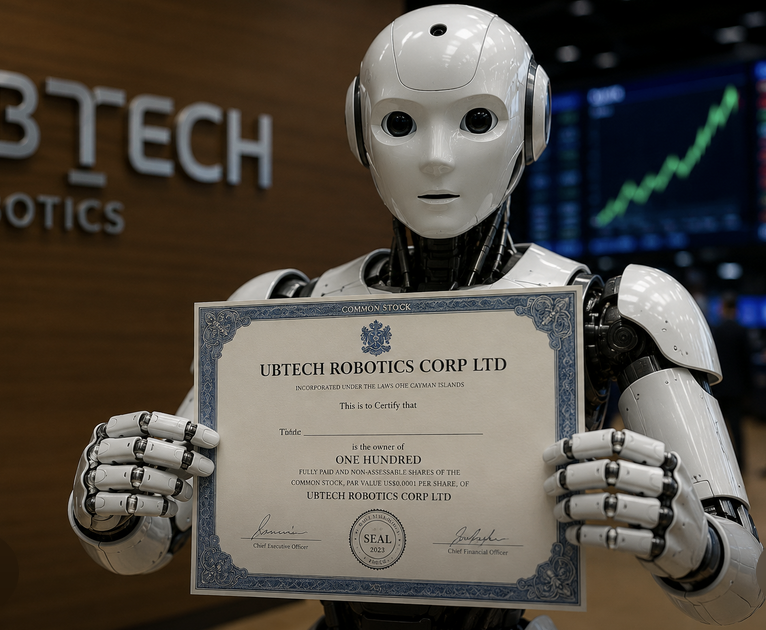
UBTECH Robotics Corp. Ltd. was established in March 2012 and is headquartered in Shenzhen, China. The company describes itself as a developer of humanoid and smart-service robots, with technology covering the hardware, software and artificial-intelligence systems required to operate humanoid robots. Unlike Unitree, whose shares trade on China’s Shanghai Stock Exchange, UBTECH is listed on the Main Board of the Hong Kong Stock Exchange under the ticker 9880.HK. It began trading on December 29, 2023, making it the first humanoid-robot company listed on the main board of the Hong Kong exchange. Its IPO price was HK$90 per share, giving the company an initial market capitalization of approximately HK$37.6 billion.
For investors looking for a publicly traded company with substantial direct exposure to humanoid robotics, UBTECH is therefore one of the most interesting stocks to investigate.
UBTECH: From Service Robots to Humanoids
UBTECH (UBTRF) did not begin with the industrial humanoids that are attracting so much attention today.
The company originally developed a broad range of service robots, including robots designed for education, commercial applications, customer service and other human-interaction environments. Its long-term strategy was to develop what it calls a full-stack robotics technology platform—essentially controlling the hardware, software, artificial intelligence and robotic-control technologies necessary to build and operate robots.
That foundation eventually led the company into humanoid robotics.
UBTECH’s Walker family became the centerpiece of this effort. The company has progressively developed more sophisticated versions of Walker, with the robots moving from demonstrations and research toward actual industrial applications.
This transition is particularly important from an investment standpoint.
A robot that can walk across a stage is impressive. A robot that can spend thousands of hours performing useful work inside a factory is potentially a business.
UBTECH is attempting to make that transition.
Walker: UBTECH’s Humanoid Robot Family
UBTECH’s best-known humanoid platform is Walker.
The company has developed several generations and versions of Walker for different applications. More recently, its attention has shifted strongly toward industrial manufacturing.
The company’s Walker S series is designed to operate in industrial environments, particularly factories and automotive manufacturing facilities.
In 2024, UBTECH reported that its Walker S industrial humanoids had begun training in multiple automobile factories. In 2025, the company introduced Walker S2, its next-generation industrial humanoid, and began mass production and deliveries.
Walker S2 incorporates an interesting feature that illustrates how UBTECH is thinking about commercial deployment: a hot-swappable autonomous battery system.
Rather than having the robot stop working for long periods while its battery recharges, the system is designed to allow the robot to change batteries and return to work. UBTECH says the system is intended to support continuous operation in industrial environments.
That may sound like a relatively minor engineering feature, but it could be extremely important commercially.
A factory operator doesn’t necessarily care whether a humanoid robot has the most sophisticated artificial intelligence in the world. The operator wants to know:
How many hours can the robot work? How reliable is it? How much does it cost? And how quickly does it pay for itself?
UBTECH’s development of Walker S2 suggests the company is increasingly focused on those questions.
A Dramatic Increase in Humanoid Revenue
Perhaps the most important development for investors appears in UBTECH’s 2025 annual report.
The company’s total revenue increased from approximately RMB 1.305 billion in 2024 to RMB 2.001 billion in 2025, an increase of 53.3%.
But the really remarkable number was humanoid robotics revenue.
Revenue from full-size embodied intelligent humanoid robot products and services increased from just RMB 35.6 million in 2024 to RMB 820.6 million in 2025.
That’s an increase of approximately 2,204%.
More importantly, humanoid robots became UBTECH’s largest source of revenue in 2025.
That is an important distinction between UBTECH and many of the larger publicly traded companies promoting humanoid robots.
For Tesla, Optimus is potentially enormous—but Tesla’s current business is dominated by automobiles, energy and other activities.
For Nvidia, robotics could become a major source of demand for its chips and computing platforms—but Nvidia isn’t a robot manufacturer.
For UBTECH, humanoid robotics is becoming the core business itself.
The Company Is Not Yet Profitable
There is, however, an important caveat for investors.
UBTECH remains loss-making.
The company’s 2025 net loss was approximately RMB 789.8 million, although that represented a significant improvement from its approximately RMB 1.160 billion loss in 2024. At the same time, gross profit increased to RMB 753.8 million, while the gross margin improved from 28.7% to 37.7%.
This is typical of a technology company attempting to commercialize an entirely new product category.
UBTECH is spending heavily on research, development, manufacturing capacity and commercialization while the humanoid market is still in its early stages.
The investment question is therefore not simply whether UBTECH can sell humanoid robots.
It is whether the company’s rapidly increasing revenue can eventually grow faster than its research, manufacturing and operating expenses, allowing the company to become sustainably profitable.
The Industrial Opportunity
UBTECH’s focus on manufacturing may give it an important advantage.
Factories are relatively structured environments. Robots don’t necessarily have to understand everything happening in the world. They need to perform specific tasks repeatedly and reliably.
UBTECH has been working with automobile manufacturers and other industrial companies to train its humanoids for manufacturing environments. Its 2025 annual report describes the year as a turning point in the industry, as humanoid robots began moving from demonstrations toward practical manufacturing applications.
The company also introduced increasingly sophisticated dexterous hands and other components designed to allow robots to manipulate objects.
This is a critical technological challenge.
Walking is only one part of being humanoid.
A useful factory robot must be able to see an object, identify it, reach for it, grasp it, manipulate it, perform the required operation and respond appropriately if something unexpected happens.
UBTECH is attempting to build the entire system.
UBTECH’s Broader Robotics Business
UBTECH isn’t exclusively a humanoid company.
It continues to develop other smart-service robotics products and applications involving areas such as AI education, logistics, elderly care and business services. The company also operates consumer-oriented brands and products.
Consequently, I would describe UBTECH as a near-pure-play humanoid robotics investment, rather than a company whose only product is humanoid robots.
But the distinction is becoming less significant as humanoid robotics becomes an increasingly large portion of the company’s revenue.
The 2025 results are particularly revealing: humanoid products and services generated RMB 820.6 million of the company’s RMB 2.001 billion in total revenue.
In other words, humanoid robotics accounted for roughly 41% of total revenue in 2025.
That is a remarkable change from only a year earlier.
UBTECH vs. Unitree
UBTECH and Unitree make an interesting comparison for investors.
Unitree is younger, having been founded in 2016, and became publicly traded on the Shanghai Stock Exchange in August 2026. It is particularly well known for its quadruped robots and relatively affordable humanoids.
UBTECH, founded in 2012, has been publicly traded since 2023 and has spent years developing humanoid and service-robot technology.
The companies also have different approaches to the market.
Unitree has developed a reputation for relatively low-cost, highly mobile robots and has achieved considerable international visibility.
UBTECH has increasingly emphasized industrial humanoids, particularly robots designed to work in factories.
That makes the two companies interesting potential competitors—but also potentially complementary investments for someone attempting to understand the emerging robotics industry.
An Important Stock-Market Advantage
There is one major advantage UBTECH has over Unitree for many international investors:
UBTECH is already publicly traded in Hong Kong.
Its ticker is 9880.HK, however it can be bought Over-the-Counter in the US with the symbol UBTRF.
Unitree’s Shanghai listing is much less accessible to the typical American investor. UBTECH’s Hong Kong listing is more visible internationally and can be followed through conventional financial-market data services.
However, that doesn’t mean UBTECH is a U.S.-listed stock. An American investor should check whether his or her brokerage permits trading Hong Kong-listed securities before considering the shares.
The Investment Case
UBTECH presents an intriguing combination of rapid revenue growth, technological development and enormous potential market opportunity.
The strongest argument for the company is that humanoid robotics has moved beyond being simply a research project. UBTECH is already generating meaningful revenue from full-size humanoids, has begun mass production of Walker S2 and is working with industrial customers.
The biggest argument against the stock is that the industry remains extremely young and UBTECH is still losing money.
There is also intense competition.
Unitree, AgiBot, Tesla, Figure AI, Apptronik, 1X, Boston Dynamics and numerous other companies are racing to develop commercially viable humanoids.
And there is no guarantee that today’s leaders will remain the leaders five or ten years from now.
Bottom Line About UBTECH
For investors researching pure-play or near-pure-play humanoid robot stocks, UBTECH deserves a prominent place on the list.
It has an established history dating back to 2012, a publicly traded stock (9880.HK), a substantial proprietary robotics technology platform, and—most importantly—rapidly increasing revenue from actual humanoid robots.
The company’s 2025 results provide perhaps the strongest evidence yet that UBTECH is moving from being a robotics-development company toward becoming a commercial humanoid-robot manufacturer.
The most encouraging figure may be the jump in humanoid revenue from RMB 35.6 million to RMB 820.6 million in one year. The most important warning sign is that the company still recorded a RMB 789.8 million net loss.
For investors, that creates the central question surrounding UBTECH:
Can the company turn the spectacular growth of its humanoid-robot business into sustainable profitability?
If it can, UBTECH could become one of the most important publicly traded pure-play investments in the humanoid-robot revolution.
Agility Robotics: A Potential U.S. Pure Play
The situation is beginning to change in the United States.
One of the most interesting companies to watch is Agility Robotics (AGLT), the developer of the humanoid robot Digit.
Agility is pursuing a very different route to the public markets. Rather than conducting a conventional IPO, the company announced in June 2026 that it would merge with Churchill Capital Corp XI (CCXI), a special purpose acquisition company, commonly known as a SPAC.
The transaction values Agility at approximately $2.5 billion and is expected to provide more than $600 million of gross proceeds. The proposed combined company is expected to trade on Nasdaq under the ticker AGLT.
What Is a SPAC?
A SPAC is essentially a publicly traded shell company created to raise money and subsequently acquire or merge with a private company.
Instead of Agility going through the traditional IPO process, Churchill Capital Corp XI provides the publicly traded vehicle through which Agility can become a public company.
The process is generally:
Private Agility Robotics → merger with Churchill Capital Corp XI → public Agility Robotics → expected ticker AGLT
As of August 2026, the transaction has not yet completed. The companies have stated that they expect the transaction to close during 2026, subject to shareholder approval, SEC review, regulatory approvals and other customary closing conditions.
Until the transaction closes, investors should not treat AGLT as an already-trading stock.
Agility’s Digit Robot
Agility’s flagship product is Digit, a bipedal humanoid robot designed primarily for industrial and logistics applications.
This is an important distinction between Agility and some of the companies pursuing humanoids for the consumer market.
Agility is focusing heavily on environments such as warehouses and manufacturing facilities, where robots could perform repetitive physical tasks that currently require human workers.
The company’s strategy is therefore relatively straightforward: build a humanoid robot capable of operating in environments designed for humans without requiring those environments to be completely redesigned.
That could ultimately be one of the most valuable characteristics of humanoid robots.
A factory or warehouse is already designed around human workers. A robot that can walk through the same doors, navigate the same aisles, reach the same shelves and manipulate the same equipment potentially can be introduced without rebuilding the entire facility.
Agility has reported more than 65,000 operating hours for Digit at customer sites and has announced more than $300 million in multi-year orders for its next-generation Digit v5 robot.
Unitree vs. Agility
The two companies represent interestingly different investment opportunities.
Unitree is already public, but its shares trade in China. It has a broad robotics portfolio, a substantial existing business and a particularly strong emphasis on relatively affordable robots.
Agility, by contrast, is still private until its SPAC transaction closes, but it could become one of the first U.S.-listed pure-play humanoid robotics companies.
For an American investor, the Agility transaction could therefore be especially significant.
If the merger is completed and AGLT begins trading on Nasdaq, investors will have something that has been difficult to find: a U.S.-listed company whose primary investment story is humanoid robotics.
The Larger Humanoid-Robot Investment Universe
Unitree and Agility are only part of the story.
Other important humanoid developers include Figure AI, Apptronik and 1X Technologies. These companies have attracted substantial investment and generated considerable interest, but they remain private companies.
There are also several large public companies with major humanoid projects:
- Tesla — developing Optimus
- Hyundai Motor — owns Boston Dynamics, developer of Atlas
- Amazon — has invested in and tested humanoid robotics
- XPeng — developing humanoid robots in addition to electric vehicles
- Nvidia — provides critical AI computing and robotics technology
These companies offer investors exposure to robotics, but they are not pure plays. A shareholder purchasing Tesla, for example, is buying an automobile, energy, artificial-intelligence and technology company—not simply a humanoid robotics company.
That distinction matters.
Why Humanoid Robots Could Become a Major Investment Theme
The investment case for humanoid robots rests on a relatively simple proposition.
The world has millions of jobs involving physical tasks that are repetitive, dangerous, physically demanding or difficult to fill. If robots can eventually perform some of those jobs economically, the potential market could be enormous.
The ultimate goal is not necessarily to build robots that look human merely for aesthetic reasons. The attraction of the humanoid form is that the world itself is designed for humans.
Humanoid robots could potentially work in factories, warehouses, hospitals, construction sites, retail stores, homes and other environments without requiring completely new infrastructure.
But there are substantial risks.
Humanoid robots remain expensive and technically challenging. Batteries, actuators, sensors, artificial intelligence, dexterous hands and reliable autonomous movement all have to work together. Demonstrations can look spectacular while commercial deployment remains difficult.
Investors should therefore distinguish between a robot that can perform an impressive demonstration and a robot that can perform useful work reliably, safely and profitably for thousands of hours.
The Bottom Line for Investors
Humanoid robotics may eventually become one of the most important new technology industries of the 2020s and 2030s. But the public investment opportunities remain limited.
Unitree Robotics is the pioneer to watch. Its August 2026 Shanghai IPO transformed it into the world’s most visible publicly traded humanoid-robot company, but its shares are not listed on a U.S. exchange. Its extraordinary first-day performance also demonstrates how much enthusiasm—and potentially speculation—surrounds the industry.
Agility Robotics could provide the next major opportunity for U.S. investors. Its proposed merger with Churchill Capital Corp XI would bring a major humanoid developer to Nasdaq under the anticipated ticker AGLT. If completed, it could give American investors one of the first direct U.S. stock-market vehicles for investing specifically in humanoid robotics.
The emergence of Unitree as a publicly traded company and Agility’s planned SPAC transaction could mark the beginning of a new stage in robotics investing: the transition of humanoid robots from venture-capital investments into publicly traded securities.
For investors, however, the most important question may not be which robot looks the most impressive. It may be which company can manufacture humanoid robots at scale, sell them at a price customers can afford, generate recurring revenue and ultimately earn a profit.
That is where the real investment opportunity—and the real investment risk—will be found.
Disclosure: Author owns some of the mentioned stocks in the article, including AMZN, TSLA, and CCXI. No investment recommendations are expressed or implied