Stocks Going Ex Dividend in March of 2026

The following is a short list of some of the many stocks going ex-dividend during the next month, which can be helpful for traders and investors interested in the stock trading technique known as “Buying Dividends” or “Dividend Capture.” This strategy involves purchasing stocks before the ex dividend date and selling them shortly after the ex-date at a similar price, while still being eligible to receive the dividend payment.

Although this dividend capture strategy generally proves effective in bull markets and flat or choppy markets, it is advisable to exercise caution and consider avoiding this strategy during bear markets. To qualify for the dividend, it is necessary to buy the stock before the ex-dividend date and refrain from selling it until on or after the ex-date.

However, it is important to note that the actual dividend may not be paid for several weeks, as the payment date may not be until two months after the ex-dividend date.

For investors seeking a comprehensive list of stocks going ex-dividend in the near future, WallStreetNewsNetwork.com has compiled a downloadable list containing numerous dividend-paying companies. Here are a few examples showcasing the stock symbol, ex-dividend date, periodic dividend amount, and annual yield.

Wendy’s Company (WEN)3/2/20260.147.48%
PayPal Holdings, Inc. (PYPL)3/4/20260.141.23%
PepsiCo, Inc. (PEP)3/6/20261.42253.40%
Domino’s Pizza Inc (DPZ)3/13/20261.991.97%
Phillips Edison & Company, Inc. (PECO)3/16/20260.10833.30%
Walmart Inc. (WMT)3/20/20260.24750.80%
Keurig Dr Pepper Inc. (KDP)3/27/20260.233.03%

To access the entire list of over 100 ex-dividend stocks, subscribers will receive an email in the next couple days with the full list. If you are not already a subscriber, you can sign up using the provided signup box below. Don’t miss out on this valuable information, and the best part is that it’s free!

Dividend Definitions

To better understand the dividend-related terms, let’s define them:

Declaration date: This refers to the day when a company announces its intention to distribute a dividend in the future.
Ex-dividend date: On this day, if you purchase the stock, you would not be eligible to receive the upcoming dividend. It is also the first day on which a shareholder can sell their shares and still receive the dividend.
Record date: This marks the day when you must be recorded on the company’s books as a shareholder to qualify for the dividend. Typically, the ex-dividend date is set two business days prior to the record date.
Payment date: This is the day on which the dividend payment is actually made to the eligible shareholders. It’s important to note that the payment date can be as long as two months after the ex-date.

Before implementing the “Buying Dividends” technique, it is crucial to reconfirm the ex-dividend date with the respective company to ensure accuracy and avoid any unexpected changes.

In conclusion, being aware of the stocks going ex-dividend can be advantageous for traders and investors employing the “Buying Dividends” strategy. WallStreetNewsNetwork.com provides a convenient resource to access a comprehensive list of such stocks, allowing individuals to plan their investment decisions effectively. Remember to stay informed and consider market conditions before employing any investment strategy.

Disclosure: Author may have positions in some of the above at the time the article was written. No investment recommendations are expressed or implied.

The “Cash-Rich” Bargain: Trading Below Cash per Share

by Fred Fuld III

In the world of value investing, few metrics signal a potential “steal” more than a stock trading below its cash per share. This scenario suggests that if a company were to shut its doors today, pay off all its obligations, and distribute the remaining cash, you would potentially walk away with more money than you paid for the stock. Essentially, the market is valuing the actual business operations at less than zero.

Why Investors Hunt for “Negative Enterprise Value”

When a stock’s price is lower than its net cash (cash minus total debt) per share, it provides a unique margin of safety.

  • Liquidation Value: The company is theoretically worth more dead than alive.
  • Acquisition Magnet: These companies are prime targets for buyouts, as an acquirer could use the company’s own cash to help fund the purchase.
  • Buyback Potential: Management can use that excess cash to buy back shares, drastically increasing the ownership stake of remaining shareholders.

The Red Flags: Why the “Bargain” Might Be a Trap

If it sounds too good to be true, sometimes it is. A stock trading below its cash value is often a signal of extreme market pessimism. You must watch out for:

  1. High Debt Loads: If a company has $10 in cash per share but $15 in debt, it isn’t “cheap”—it’s underwater. Always look at Net Cash (Cash – Total Debt).
  2. Cash Burn: In industries like biotech or tech, a company might have a mountain of cash today but be losing so much money monthly that the cash will be gone in a year.
  3. Governance Issues: Sometimes cash is “trapped” in foreign subsidiaries or controlled by management that refuses to return it to shareholders.

Profile of Potential Value Stocks

While some companies often have high cash balances, it is vital to distinguish between Gross Cash and Net Cash (after debt).

Harley-Davidson (HOG)

Harley-Davidson often appears in value screens due to its massive financing arm (HDFS), which holds significant cash but also carries substantial debt.

  • Market Status (Feb 2026): Trading around $20.14.
  • The Profile: HOG is currently viewed as a deep-value play, trading at a P/E of roughly 4.7x, significantly below its peers.
  • Watch Out For: The company faces declining motorcycle shipments (down ~17-22% recently). Its cash is often tied to its financial services wing, meaning the “cash per share” can be misleading if you don’t account for the debt used to fund those motorcycle loans.

Interactive Brokers (IBKR)

As a brokerage, IBKR’s balance sheet is unique. It holds vast amounts of client cash, which can inflate “cash per share” metrics.

  • Market Status (Feb 2026): Trading around $74.90.
  • The Profile: IBKR has seen a massive run-up (up 30% in the last year). It holds over $105B in cash and short-term investments, but its debt-to-equity ratio sits at about 121%.
  • Watch Out For: Valuation. While cash-rich, many analysts consider it overvalued at current prices because the market is already pricing in high interest-income margins.

TriNet Group (TNET)

TriNet provides HR solutions and often carries a “light” balance sheet with significant cash flow.

  • Market Status (Feb 2026): Trading around $42.00 after a recent 28% plunge.
  • The Profile: Following a lowered 2026 outlook, the stock is currently in the “doghouse.”
  • Watch Out For: Rising healthcare costs are eating into their margins. While they have a history of aggressive buybacks, the current net loss in Q4 2025 suggests the cash pile might be needed for operations rather than being “excess.”

WEX Inc. (WEX)

WEX operates in the financial technology space, focusing on fleet and corporate payments.

  • Market Status (Feb 2026): Trading around $157.00.
  • The Profile: Analysts suggest the stock is significantly undervalued based on future cash flow models (some estimates as high as $400/share).
  • Watch Out For: High Leverage. WEX has a debt-to-equity ratio of 4.49, which is much higher than the industry average. This is a classic example of where “cash per share” can be a trap if you ignore the massive debt obligations.

Keep in mind that cash may not always be king.

Disclosure: Author owns HOG.

Green Bay Packers Stock Certificate to be Auctioned: Estimate $100,000

by Fred Fuld III

A few months ago, I wrote an article about investing in antique stock certificates, mentioning some that have been signed by Wells & Fargo, J.P. Morgan, and Harry Houdini.

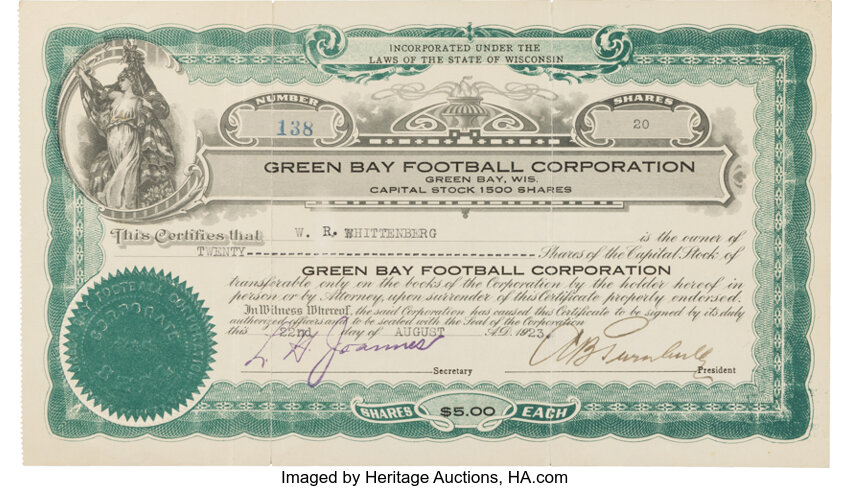
Now sports fans, and fans of stock market and investment related collectables have the chance to acquire an extremely rare item, a Green Bay Packers stock certificate from 1923.

The certificate was issued for 20 shares by the Green Bay Football Club, from Green Bay, Wisconsin.

This extremely rare historical document will be auctioned off by Heritage Auctions in their 2026 February 28 – March 1 Winter Platinum Night Sports Catalog Auction. Pre-bidding is already taking place.

At the time this article is being written, the current bid price is $40,000, and with the buyer’s premium, $48,800.

The certificate is estimated to hammer at $100,000 or more.

Now is your chance to bid!!!

Photo courtesy of Heritage Auctions.

Can You Predict the Future of Predictive Markets?

by Fred Fuld III

In 2026, the world of prediction markets has moved from the fringes of the internet to the center of global finance.These platforms are essentially information exchanges where users buy and sell contracts on the likelihood of real-world outcomes. If you think a candidate will win an election or a tech giant will hit its earnings target, you buy a “Yes” contract. If the event happens, the contract pays out; if it doesn’t, it expires worthless.

The beauty of these markets is their accuracy. Because participants have “skin in the game,” the price of a contract serves as a real-time, crowd-sourced probability that often outperforms traditional polling and expert analysis.

Here is a breakdown of the primary prediction market platforms available today.


1. Kalshi

The Regulated Heavyweight Kalshi is currently the dominant player in the U.S. market. It operates as a federally regulated exchange overseen by the Commodity Futures Trading Commission (CFTC). This regulation allows it to offer a high degree of trust and seamless integration with U.S. bank accounts.

  • Availability to US Citizens: Fully Available. Kalshi is a U.S.-based company and is legal for residents in most states (though some states like Massachusetts and New Jersey have recently challenged or geofenced specific sports markets).
  • Event Types: Known for “macro” events. You can bet on Federal Reserve interest rate hikes, inflation data, Box Office totals, Rotten Tomatoes scores, and—most famously—elections. In late 2025, they expanded significantly into sports event contracts (e.g., NFL, NBA).

2. Polymarket

The Crypto Giant Polymarket is the world’s largest decentralized prediction market. Built on the Polygon blockchain, it uses the USDC stablecoin for all transactions. After being restricted in the U.S. for several years, it began a regulated comeback via a new legal framework in late 2025.

  • Availability to US Citizens: Limited / Phased Rollout. As of February 2026, Polymarket is returning to the U.S. through a regulated channel. While many U.S. users are still on waitlists, the platform is increasingly accessible compared to its previous “offshore-only” status.
  • Event Types: Unrivaled variety. Polymarket covers everything from global geopolitical conflicts and crypto price movements to pop culture “memes” and scientific breakthroughs. If it’s being talked about on the internet, there is likely a market for it on Polymarket.

3. PredictIt

The Political Laboratory PredictIt is a project of Victoria University of Wellington and serves primarily as an educational and research tool. Because it operates under a “no-action” letter from the CFTC (though this has been the subject of intense legal battles), it has strict limits on how much a single person can invest.

  • Availability to US Citizens: Fully Available. It is specifically designed for the U.S. market, though it has a $3,500 position limit per contract to keep it focused on research rather than institutional speculation.
  • Event Types: Politics only. PredictIt does not offer sports or weather. It focuses exclusively on U.S. elections, Supreme Court rulings, and legislative outcomes.

4. Robinhood (HOOD) & Interactive Brokers (IBKR) [ForecastEx]

The Traditional Entrants In the last year, major traditional brokerages have entered the fray. Robinhood now offers election and event contracts directly in its app, often routing orders through Kalshi’s infrastructure. Interactive Brokers launched ForecastEx, a dedicated exchange for economic and climate-related predictions.

  • Availability to US Citizens: Fully Available. These are standard U.S. financial institutions.
  • Event Types: Mostly focused on “serious” data: Economic indicators (CPI, unemployment), climate data (global temperature averages), and major political milestones.

While prediction markets are powerful forecasting tools, they are not “safe” investments like savings accounts. Because they are binary (paying out either $1 or $0), they carry unique risks that combine the volatility of tech stocks with the “all-or-nothing” nature of sports betting.

As of early 2026, these are the primary risks you face when trading these markets:


1. Regulatory & Legal Risk

The “legal status” of these platforms is a moving target. Even if a platform is federally regulated, state-level challenges remain a major hurdle.

  • State-Level Shutdowns: In early 2026, several states (including New Jersey and Maryland) issued cease-and-desist letters to platforms, claiming they bypass state gambling laws. You could find your account geofenced or restricted with little notice.
  • Tax Uncertainty: The IRS has not yet issued formal guidance on whether prediction market gains are “capital gains” or “gambling winnings.” This could lead to unexpected tax liabilities or penalties if you misreport your earnings.

2. Insider Trading & Information Asymmetry

Unlike the stock market, where insider trading is a strictly enforced crime, prediction markets often rely on insiders to move the price toward the “truth.”

  • The “Whale” Effect: Large traders with deep pockets or non-public information (e.g., a political staffer who knows a bill will fail) can move the price before you have a chance to react.
  • Enforcement Risk: On February 5, 2026, federal prosecutors in New York signaled they would begin charging traders who use “material non-public information” with wire fraud, moving toward a stricter enforcement era.

3. Liquidity & Execution Risk

Liquidity refers to how easily you can enter or exit a trade without significantly changing the price.

  • The “Exit” Problem: In “thin” markets (low volume), you might buy a contract at $0.60, but when you want to sell, the best buyer is only offering $0.50—even if no news has changed.
  • Slippage: If you try to place a large bet on a niche topic (like a specific scientific discovery), your own buy order might push the price from $0.30 to $0.45, instantly destroying your potential profit margin.

4. Platform & Technical Risk

Because many of these platforms use “Web3” or hybrid infrastructure, they face unique technical vulnerabilities.

  • Oracle Failure: A “Yes” or “No” payout depends on an Oracle (the data source that confirms the outcome). If an Oracle is hacked or provides ambiguous data, your funds could be locked in a dispute for months.
  • Account Security: In late 2025, a major breach of a third-party authentication provider highlighted that even if the “blockchain” is safe, the login screen might not be.

5. Manipulation & “Noise”

Prediction markets can be susceptible to intentional distortion.

  • Wash Trading: Some participants may trade back and forth with themselves to create the illusion of high volume and interest.
  • Propaganda Bets: Political campaigns or wealthy donors have been known to place massive bets to make their candidate look more likely to win in the media, creating a “narrative” that isn’t backed by actual data.

Keep these risks in mind before dipping your toe into predictive markets.

Disclosure: Author didn’t own any of the above stocks at the time the article was written. No recommendation are expressed or implied.
Is Stock Market Margin Debt Too High? Will It Cause a Crash?

by Fred Fuld III

You may think that investors use a lot less margin debt than in the past because of the increase in the use of put options to play the downside of stocks and ETFs.

However, margin debt has grown from $701 billion to $1.23 trillion since 2023.

Margin debt as a percentage of market cap of the stock market has gone from 1.6% to 2.3% $1.23 trillion over the last three years.

Tracking margin debt as a percentage of market capitalization is a classic “canary in the coal mine” for market analysts. Because the NYSE and NASDAQ combined represent nearly the entire US equity market, researchers often use the Wilshire 5000 or the S&P 500 as a proxy for total market cap.

Historically, FINRA (which took over reporting from the NYSE in 2008) provides the most reliable data starting from 1997. Below is a reconstructed table showing the approximate margin debt as a percentage of total US market capitalization (proxied by the Wilshire 5000 or S&P 500) over the last 30 years.

Historical Margin Debt vs. Market Capitalization (1996–2026)

YearApprox. Margin Debt ($B)% of Market CapMarket Context
1996~$1001.1%Pre-Dot-com buildup
2000$2782.6%Dot-com Bubble Peak
2002$1301.3%Post-bubble bottom
2007$3812.5%Pre-GFC Housing Peak
2009$1731.6%Post-GFC bottom
2014$4652.1%Steady recovery
2018$5542.3%Trade war volatility
2021$9352.0%Post-COVID Peak
2023$7011.6%Interest rate hike cooling
2024$8991.8%AI-driven rally
2025$1,2252.2%New Nominal Record
2026*$1,230+2.3%Current cycle highs

*Data through early 2026 based on recent FINRA January reports.


Key Observations

  • The 3% Ceiling: Historically, margin debt rarely exceeds 3% of the total market capitalization. When the ratio approaches or exceeds 2.5%, it is often viewed as a “yellow flag” indicating over-leverage and high speculative fervor.
  • Nominal vs. Relative Peaks: While the current 2026 nominal debt is at an all-time high (exceeding $1.2 trillion), the percentage of market cap is still lower than it was at the peak of the 2000 and 2007 bubbles because the total market value has grown even faster.
  • Forced Liquidation: The danger of high margin debt isn’t the borrowing itself, but the “feedback loop” it creates during a downturn. As stock prices fall, margin calls trigger forced selling, which further lowers prices and triggers more margin calls.

Disclosure: No investment recommendations are expressed or implied.

Do Companies that Pay Their CEOs One Dollar a Year Perform Better?

by Fred Fuld III

While the “one-dollar CEO” was once a popular trend among Silicon Valley elite (like Larry Page and Mark Zuckerberg), it has become a rarer breed in the 2020s. Most CEOs who famously took $1 salaries have either stepped down or shifted their compensation structures.

Steve Jobs is often credited with popularizing the modern “$1 CEO” trend. After rejoining Apple in 1997, he famously took a $1 annual salary for 14 years until his resignation in 2011.

While his salary was a single dollar, his performance—and the stock’s performance—was anything but nominal.

Apple’s Performance Under the $1 Salary (1997–2011)

When Jobs returned, Apple was weeks away from bankruptcy and trading at split-adjusted prices that are today measured in pennies. By the time he stepped down, he had transformed it into the most valuable company in the world.

  • Stock Growth: Apple’s stock (AAPL) grew by approximately 6,700% during his tenure.
  • vs. S&P 500: During that same period, the S&P 500 returned roughly 4.5% per year (heavily suppressed by the Dot-com bubble burst and the 2008 Financial Crisis). Apple averaged a staggering 33.6% annual return.
  • Revenue: Apple’s annual revenue exploded from $7.1 billion in 1997 to $108.2 billion in 2011.

Was he actually only making $1?

While the salary was symbolic, Jobs was compensated in other massive ways that aligned his wealth with the company’s success:

  1. Massive Stock Ownership: Jobs held about 5.5 million shares of Apple. He didn’t sell a single share between 1997 and 2011, meaning his “paycheck” was effectively the billions of dollars in value added to his holdings.
  2. The “Bonus” Jet: In 1999, Apple’s board gave him a $90 million Gulfstream V private jet and reimbursed him for all expenses related to it.
  3. Disney Stock: Jobs was also the largest individual shareholder of Disney (following the sale of Pixar), which paid him millions in dividends annually—far more than any CEO salary could.

The Verdict on the $1 Salary

Jobs is the ultimate success story for this model because his $1 salary signaled a “sink or swim with the shareholders” mentality. He took the dollar when the company was failing to prove his commitment, and he kept it when the company was winning to show that his motivation was the product, not the cash.

Most modern CEOs who try this (as seen in the 2025 performance data) haven’t quite managed to replicate that “Jobs Magic” in terms of raw market outperformance.

However, a few notable examples still exist or have recently committed to this path. Here is how they and their stocks have fared over the last year (ending early 2026) compared to the S&P 500, which returned approximately 16.3% in 2025.


The $1 CEO Club: Performance vs. S&P 500

CompanyCEO2025 Stock Performancevs. S&P 500 (+16.3%)
Tesla (TSLA)Elon Musk+19%Outperformed
Airbnb (ABNB)Brian Chesky~ -5%Underperformed
Yelp (YELP)Jeremy Stoppelman-32%Underperformed
Gloo (GLOO)Scott BeckN/A (New for 2026)N/A

Key Company Breakdowns

  • Tesla (TSLA): Elon Musk remains the most famous member of this group. While his base salary is $0 (or the California minimum wage, which he does not accept), his actual compensation is tied to massive performance-based stock options. In 2025, Tesla’s stock was a roller coaster—dropping significantly in Q1 before rallying on the launch of its robotaxi network to end the year up 19%, slightly beating the broader market.
  • Yelp (YELP): Jeremy Stoppelman has maintained a $1 salary for years. Unfortunately for shareholders, 2025 was a difficult year for Yelp. Despite high gross margins, the stock tumbled 32% over the last year as it struggled with slower customer spending and a transition toward AI-driven local commerce services.
  • Airbnb (ABNB): Brian Chesky famously reduced his salary to $1 during the pandemic. While he receives other forms of compensation (like security and travel), his base remains nominal. The stock saw modest volatility in 2025, ending the year down roughly 5% as the travel sector normalized after the post-pandemic boom.
  • Gloo (GLOO): A newer entry to the list, Gloo announced that its CEO Scott Beck would slash his salary to $1 starting in February 2026 to signal confidence in the company’s “faith-tech” platform despite recent net losses.

Is the “$1 Salary” a Good Sign for Investors?

The data suggests that a $1 salary is not a guarantee of stock success. While it aligns the CEO’s wealth with shareholders, it often indicates that the executive is already a billionaire (like Musk or Chesky) or that the company is going through a “turnaround” phase where cash preservation is critical. In 2025, the $1 CEO group largely underperformed the S&P 500, with Tesla being the lone standout.

Disclosure: Author owns AAPL and TSLA. No investment recommendations are expressed or implied.