Have you ever thought about trading or investing in an agricultural commodity, possibly as an inflation hedge, such as wheat, corn, soybeans, or even coffee?
But maybe you didn’t want to get into futures because of the risk or lack of understanding or both.
Well, there is another way to trade these food items, and that is through the agricultural commodities exchange traded funds.
Probably the safest way is through an ETF that has a diversified portfolio of agricultural products, such as the Invesco DB Agriculture Fund (DBA), which has an investment objective of investing in a portfolio of exchange-traded agricultural futures.
If you think the price of corn is going to take off, you could trade the Teucrium Corn Fund (CORN).
Or maybe you think the demand for sugar is going to increase, causing the sugar price to spike. You have a couple of alternatives, the iPath Series B Bloomberg Sugar Subindex Total Return ETN (SGG) and the Teucrium Sugar Fund (CANE).
If you like chocolate, there is the iPath Bloomberg Cocoa Subindex Total Return ETN (NIB).
The following is a list of the agricultural commodities ETFs.
Commodity
Symbol
ETF Name
Total Assets*
Agriculture
DBA
Invesco DB Agriculture Fund
1,018,170
Agriculture
RJA
Elements Rogers International Commodity Index-Agriculture Total Return ETN
153,758
Corn
CORN
Teucrium Corn Fund
120,848
Coffee
JO
iPath Series B Bloomberg Coffee Subindex Total Return ETN
94,895
Wheat
WEAT
Teucrium Wheat Fund
75,645
Soybean
SOYB
Teucrium Soybean Fund
44,971
Sugar
SGG
iPath Series B Bloomberg Sugar Subindex Total Return ETN
26,419
Sugar
CANE
Teucrium Sugar Fund
22,844
Cocoa
NIB
iPath Bloomberg Cocoa Subindex Total Return ETN
22,713
Grains
JJG
iPath Series B Bloomberg Grains Subindex Total Return ETN
21,563
Cotton
BAL
iPath Series B Bloomberg Cotton Subindex Total Return ETN
20,602
Livestock
COW
iPath Series B Bloomberg Livestock Subindex Total Return ETN
19,665
Agriculture
TAGS
Teucrium Agricultural Fund
14,180
Agriculture
JJA
iPath Series B Bloomberg Agriculture Subindex Total Return ETN
11,211
* In thousands
You will notice that some of these are ETNs (Exchange Traded Notes) as opposed to ETFs. ETNs are senior, unsecured debt securities similar to a bond
Keep in mind that these funds are very volatile, very speculative, and can have low volume and very wide spreads.
About a week ago, I heard an analyst on CNBC being interviewed about meme stocks, although he didn’t pronounce it “meeem”, he pronounced it “me-me”. Do you think it was accidental, through ignorance, or on purpose with a hidden meaning?
Whatever you call them, the meme stocks have had a wild ride last year. Surprisingly, a few of them performed extremely well, but many ended up dropping over 40% for the year.
Interestingly, the top performers were GameStock, I mean GameStop (GME) (did I type it that way accidentally or on purpose?), up 688%, and AMC Entertainment (AMC), which rose by 1183%.
The memes that tanked the most were Clovis (CLOV) down 78% and ContextLogic Inc. (WISH), which dropped by 83%.
The following is a list of the meme stocks and semi-meme stocks along with the January 1 to December 31 performance for the year 2021.
GME
688%
AMC
1183%
CLOV
-78%
CRON
-43%
DASH
4%
FVRR
-42%
HOOD
-49%
IQ
-74%
OTLY
-61%
WE
-27%
WISH
-83%
BB
41%
SNDL
22%
BYND
-48%
SLV
-12%
Maybe we will see some meme action again this year. What do you think?
by Fred Fuld III Editor & Publisher, Wall Street News Network
Have you ever had to negotiate with your boss about a pay raise, or try to raise money for your company, or interview for a job, or sell a product or service, or even ask someone for a date? If so, it means that you had to give a pitch.
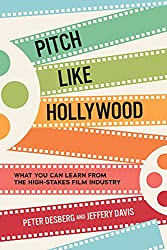
The book, Pitch Like Hollywood: What You Can Learn from the High-Stakes Film Industry, by Peter Desberg and Jeffrey Davis, is all about pitches. The authors show how to create a pitch, how to prepare for a pitch, how to present your pitch, how to deal with pitch panic, and other strategies. This guide even tells you the best time of day to make a pitch.
The book is also useful for those who have to give speeches.
Don’t let the word “Hollywood” in the title deter you from reading this book. Examples from many different industries are included, such as aerospace, education, automobile, technology, advertising, and many others.
The most important aspect of this book that I liked the most was the extensive research and studies that were done to back up what the book presented.
My favorite chapter was Chapter 5 – Persuasion Bootcamp, where the authors present and describe all of the Compliance Gaining Techniques.
It doesn’t matter if you are the head of a startup, or working your way up the corporate ladder, or trying to promote your book to a publisher, or just trying to sell your products or services to a customer or client, I highly recommend Pitch Like Hollywood to anyone who is ever involved in persuasion.
We recently published an article on tax selling stocks, which listed several stocks that had dropped significantly this year. Tax selling stocks are ones which are overly depressed in price due to stockholders wanting to take advantage of their capital losses before year-end. Often, these stocks bounce in January when the selling pressure is off.
Some stock traders like to look for additional criteria when they choose which tax selling stocks to buy, and one that is popular is below-cash stocks. These are stocks that if you divided the company’s total cash by the number of outstanding shares, that cash value exceeds the current stock price.
In other words, the stock is trading below the amount of cash available per share. With that much cash, it is hard for a company to go out of business within a month. In addition, it sometimes makes these stocks takeover opportunities.
Of course, there is no guarantee that these stocks will bounce in January. They could continue to drift downward or stay around the same price for a long time.
Here is a list of non-biotech stocks that are down over 50% year-to-date and are selling below cash per share. Also, all of these are selling below $7 per share. In addition, many of them have had increasing revenues over the past few years.
AFIB
AQB
ASTC
BTBT
CMMB
CNTX
DSS
EKSO
FKWL
FNHC
FVE
LCI
MAPS
MYPS
NUWE
ONVO
ROOT
SLDB
VIVE
Please keep in mind that these are extremely low cap stocks and are therefore extremely speculative.
Disclosure: At the time the article was written, author owned AFIB AQB ASTC BTBT CMMB CNTX DSS EKSO FKWL FNHC FVE LCI MAPS MYPS NUWE ONVO ROOT
The following is a short list of some of the many stocks going ex dividend during the next month.
Many traders and investors use the stock trading technique called ‘Buying Dividends,’ also commonly referred to as ‘Dividend Capture.’ This is the strategy of buying stocks before the ex dividend date and selling the stock shortly after the ex date at about the same price, yet still being entitled to the dividend.
This technique generally works in bull markets and flat or choppy markets, but you need to avoid the strategy during bear markets. In order to be entitled to the dividend, you have to buy the stock before the ex-dividend date, and you can’t sell the stock until after the ex date.
The actual dividend may not be paid for another few weeks. WallStreetNewsNetwork.com has compiled a downloadable and sortable list of the stocks going ex dividend in the near future. The list contains many dividend paying companies, lots with market caps over $500 million, and some with yields over 2%. Here are a few examples showing the stock symbol, the ex-dividend date, the periodic dividend amount.
Cisco Systems, Inc. (CSCO)
1/4/2022
0.37
2.41%
Campbell Soup Company (CPB)
1/5/2022
0.37
3.53%
WD-40 Company (WDFC)
1/13/2022
0.78
1.23%
Lowe’s Companies, Inc. (LOW)
1/18/2022
0.80
1.28%
Clorox Company (CLX)
1/25/2022
1.16
2.72%
Hasbro, Inc. (HAS)
1/31/2022
0.68
2.82%
The additional ex-dividend stocks can be found HERE . (If you have been to the page before, and the latest link doesn’t show up, you may have to empty your cache.) If you like dividend stocks, you should check out some of the other high yield stock lists at WSTNN.com HERE .
Dividend definitions:
Declaration date: the day that the company declares that there is going to be an upcoming dividend.
Ex-dividend date: the day on which if you buy the stock, you would not be entitled to that particular dividend; or the first day on which a shareholder can sell the shares and still be entitled to the dividend.
Record date: the day when you must be on the company’s books as a shareholder to receive the dividend. The ex-dividend date is normally set for stocks at two business days before the record date.
Payment date: the day on which the dividend payment is actually made, which can be as long at two months after the ex date.
Don’t forget to reconfirm the ex-dividend date with the company before implementing this technique.
Disclosure: Author did not own any of the above at the time the article was written; affiliate links are on this page.
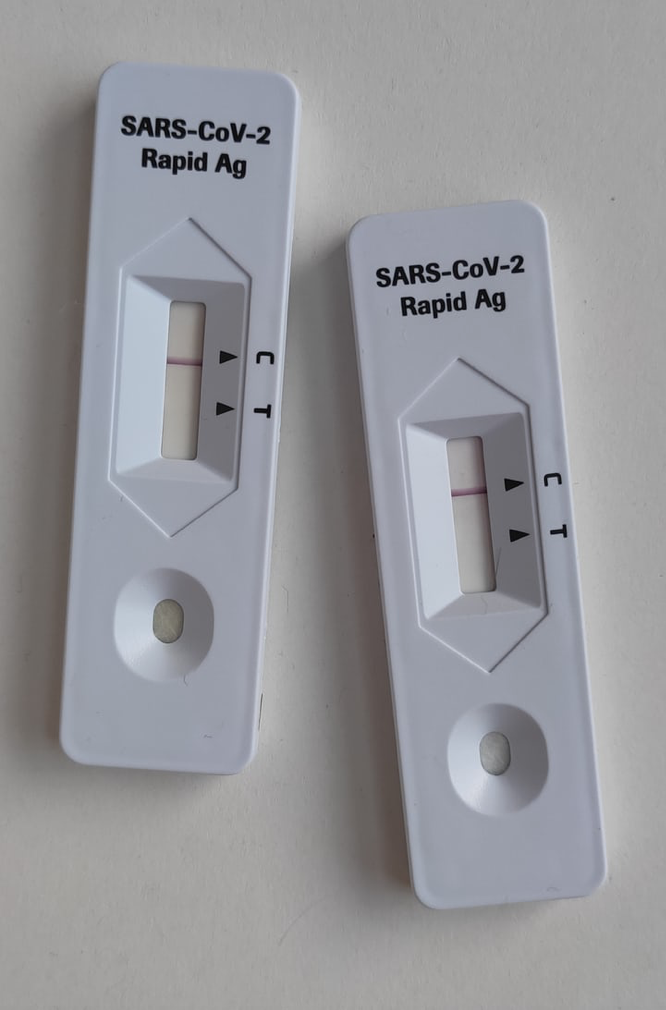
By now, you have probably heard the news. President Biden has announced that the U.S. Government will be buying 500 million take-at-home COVID test kits to distribute to Americans.
You will be able to order your free COVID test kit from a website in January.
So who is making the test kits? The government hasn’t announced yet what company or companies it will be buying from, but there are several business involved in producing these kits.
For example, Abbott Labs (ABT) is one of the largest manufacturers of COVID test kits. The company produces five different antigen tests (including theBinaxNow COVID-19 Ag Card2 Home Test), three different PCR tests, three different serological tests, and one isothermal amplification test.
Becton, Dickinson (BDX), which makes several COVID tests, has a BD Veritor At-Home COVID-19 Test.
Quidel Corporation (QDEL), produces many COVID tests, has two at-home COVID tests.
Even Amazon (AMZN) is getting in on the act in partnership with SDS Lab Holdco.
The following is a list of the publicly traded stocks that produce COVID tests. Not all of these companies make an at-home test.
Amazon $AMZN has just released its list of the top selling books on Kindle. In addition, Amazon is offering three months of Kindle Unlimited for just $0.99 through the end of 2021. This includes over two million eBooks, thousands of audiobooks, and up to three select magazine subscriptions.
So what are the top Kindle books? The top five titles in Kindle Unlimited in 2021 are:
The stock market has been suffering during the last several days. As I write this, the Dow Jones Industrial Average is down 528, and the SPY is down 5.85. Since the market has dropped so much, now might be the time to look for short squeeze opportunities.
Here is a quick review about the short squeeze and its terminology. When you short a stock, it means that your goal is to make money from a drop in the price of a stock. Technically, what happens is that you borrow shares of a stock, sell those shares, then buy back those shares at a hopefully lower price so that those shares can be returned. This all happens electronically, so you don’t actually see all the borrowing and returning of shares; it just shows up on your screen as a negative number of shares.
Short selling can be profitable, but sometimes when the stock moves against the short sellers, and begins to rise, the short sellers jump in right away to buy shares to cover their positions, creating what is called a short squeeze. When a short squeeze takes place, it can cause the share prices to increase fast and furiously. Any good news can trigger the short squeeze.
Some traders utilize this situation by looking for stocks to buy that may have a potential short squeeze. Here is what a short squeeze trader should take into consideration:
Short Percentage of Float ~ The float is the number of freely tradable shares and the short percentage is the number of shares held short divided by the float. Amounts over 10% to 20% are considered high and potential short squeeze plays.
Short Ratio / Days to Cover / Short Interest Ratio -This is probably the most important metric when looking for short squeeze trades, no matter what you call it. This is the number of days it would take the short sellers to cover their position based on the average daily volume of shares traded. This is a significant ratio as it shows how “stuck” the short sellers are when they want to buy in their shares without driving up the price too much. Unfortunately for the shortsellers, the longer the number of days to cover, the bigger and longer the squeeze.
Short Percentage Increase ~ This is the percentage increase in in the number of short sellers from the previous month.
Check out the following list, but be aware, that often some stocks are heavily shorted for a reason. All these stocks have significant short metrics, but they have very low market caps and floats.
Company
Symbol
Short Interest
Days to Cover
Float
Cortexyme Inc
CRTX
59%
4.7
15.54M
Intercept Pharmaceuticals
ICPT
35%
10.5
23.58M
Blink Charging Co
BLNK
34%
3.9
36.46M
Beyond Meat Inc
BYND
34%
6.2
56.16M
iSpecimen Inc
ISPC
33%
0.2
3.27M
Gogo Inc
GOGO
32%
6.9
45.67M
So as an example, Cortexyme has 59% of the float shorted, and it will take almost five days for the short sellers to cover their positions, based on the average daily volume.
Obviously, there is no guarantee that these stocks will go up, but if I was short any stock, I wouldn’t want to waste any time covering my position if the stock started to move up sharply, before all the other short sellers clamor in and drive the price way up.
Disclosure: Author didn’t own any of the above at the time the article was written
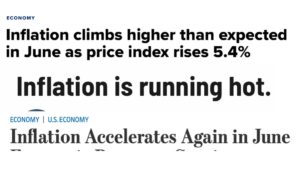
You have seen the headlines during the last several months. You have noticed the price increases on Amazon (AMZN), in your supermarket, and even at the dollar stores (which should probably now be called the $1.25 stores). Have you considered using gold as an inflation hedge?
Inflation is here and it’s getting worse. Investors and traders that understand this are now looking for ways to profit from inflation.
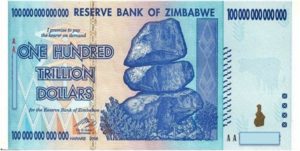
Of course no one expects hyperinflation, as was seen in Zimbabwe in 2008.
In Zimbabwe, the country’s peak month of inflation is estimated at 79.6 billion percent month over month, and 89.7 sextillion percent year over year in mid-November of 2008. That’s an inflation rate in numerical terms of 89,000,000,000,000,000,000,000%.
Back then, it cost billions of dollars just to buy basic food items. Inflation was so bad that the country allowed currencies from other countries to be used in April 2009. In 2015, Zimbabwe switched to the U.S. dollar as its national currency.
In 2019, Zimbabwe reintroduced the Zimbabwe dollar, but unfortunately, hyperinflation has hit the country again, measuring 737% last year.
So what is a trader and investor to do? Here are several ways to make gold work for you.
Gold
Gold has long been considered a primary inflation hedge. Over the last 20 years, the price of gold has increased by 597%, which works out to an annualized return of 10.19%. Taking inflation into consideration, gold has gone up by 335%, or 7.622% annualized.
Many studies have shown that gold has provided superior returns during times of inflation. In addition, according to a study at the Stern School of Business at New York University, “overall gold by itself is a safe haven with respect to exhibiting lower volatility in response to shocks or negative return days.”
The big question is, if you want to invest in gold, how should you do it?
Physical Gold
Physical gold means gold that you can hold in your hot little hands. This could either be gold bullion or gold coins.
Gold Bullion
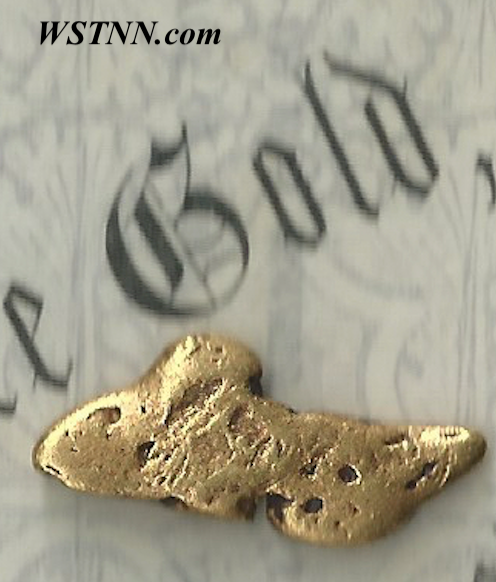
Gold bullion is sometimes referred to as gold bars, similar to the bars in Fort Knox. They can be as small as one gram or as large as 400 ounces (27.5 pounds).
The big advantage of gold bullion is privacy. Bullion bars can be kept anywhere: a home safe, a safe deposit box, or in the ground. Another advantage is that bullion is generally less expensive than gold coins, even bullion gold coins.
Gold Bullion Coins
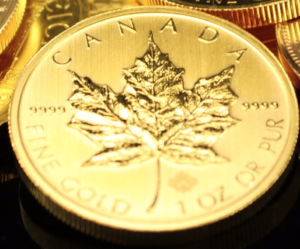
Gold bullion coins are coins that are issued by governments with a very high gold content, but very little or no numismatic value, but are issued as legal tender. In other words, they sell for very close to the price of gold. These coins include the American Gold Eagle and the Canadian Maple Leaf.
These coins also have the benefit of privacy, but they are also issued in various denominations, making them easier to trade. For example, if you have a one ounce gold bar but you want to sell one quarter of the gold, you would be stuck. However, you do have the ability to own four American Eagle quarter-ounce gold coins, or even ten 1/10th ounce coins.
Many investors believe that the gold coins have better liquidity than bullion. However, the premium on gold coins is higher than the premium on bullion, and the smaller the denomination of the coin, the higher the premium.
Numismatic Gold Coins
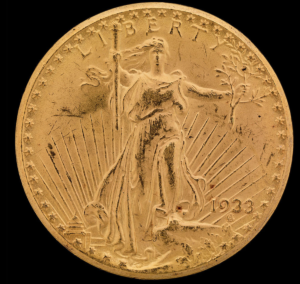
Numismatic gold coins are coins which have value due to their scarcity, physical appearance, condition, and many other factors. They are collected by coin collectors.
National Numismatic Collection, National Museum of American History
The big advantage is that the value of these coins can increase far more than the value of gold, and can even go up in price if the gold price stays the same or even drops. They are less liquid than bullion coins and have a much bigger spread (the price at which you pay for the coin versus what you can sell it for). The other disadvantage is that the coins have a much higher premium than bullion coins.
There is one big estate tax advantage to owning U.S. numismatic gold coins. Talk to your accountant about it. It is currently legal and above board as far as I know, but I am not an accountant or tax attorney. Consult yours.
Gold Securities
Gold ETFs
Gold ETFs are Exchange Traded Funds that have a goal of tracking the price of gold. There are many of them including SPDR Gold Shares (GLD), iShares Gold Trust (IAU), and SPDR Gold MiniShares Trust (GLDM).
There are even some leveraged gold ETFs, such as ProShares Ultra Gold (UGL), which has a goal of providing twice the daily leverage of gold prices.
Gold Mining Stocks
There are many gold mining companies to choose from. The smaller companies are referred to as junior miners (not minor miners). Some of the bigger ones include Newmont Mining (NEM), Barrick Gold (GOLD),AngloGold Ashanti (AU), and Kinross Gold (KGC).
Gold Royalty Trusts
Gold Royalty Trusts do not do any mining. What they do is provide money to mining companies in return for receiving a stream of income based on a percentage of revenues or percentage of gold production.
Some of the biggest gold trusts are Franco-Nevada (FNV), Wheaton Precious Metals (WPM), Royal Gold (RGLD), and Osisko Gold Royalties (OR).
Gold Miners ETFs
Gold Miners ETFs are Exchange Traded Funds that invest in gold mining stocks. VanEck Vectors Gold Miners ETF (GDX) is the largest of these ETFs. VanEck Junior Gold Miners ETF (GDXJ) holds the smaller (junior) mining companies. Direxion Daily Gold Miners Index Bull 2x Shares (NUGT) is a double bullish ETF.
Gold Futures
One other way to invest in gold, which is the most speculative way, is through gold futures. These are exchange-traded contracts to buy or sell a specific amount of gold in the future at a specified price. The returns can be substantial but so are the risks, as your losses can far exceed the original investment that you put up.
How Much Should You Invest in Gold
Many financial advisors recommend that you hold a small amount of gold, up to 5% to 10% of your portfolio as a hedge. Hopefully, gold will make your portfolio sparkle and shine.
Disclosure: Author is long AMZN, GLD, WPM, and OR.