
by Fred Fuld III
The recent wave of technology outages, airline groundings, and disruptions to critical services has given Americans something new to think about: How prepared are we if the systems we depend on every day suddenly stop working?
On November 13, 2026, the Federal Aviation Administration (FAA) experienced a telecommunications network failure that resulted in a nationwide ground stop. The disruption lasted approximately four hours and 45 minutes, with more than 12,000 flight cancellations reported that day. The problem affected 17 of the FAA’s 22 Air Route Traffic Control Centers. Although the FAA said that all aircraft landed safely, the incident demonstrated how a technical failure in one critical system can disrupt transportation across the country.
There have also been other unsettling developments. United Airlines experienced a separate technology outage that disrupted flights at several major airports, including San Francisco International Airport. Meanwhile, the National Security Agency (NSA) experienced an outage of its internal classified information network on November 17. The NSA attributed the disruption to scheduled maintenance, and officials said there was no evidence of a cyberattack. Nevertheless, the incident raised questions about the reliability of even highly sophisticated government computer systems.
These events have fueled concerns about how vulnerable modern society has become to technology failures, cyberattacks, power outages, natural disasters, and interruptions in essential services. People increasingly recognize that electricity, communications, transportation, banking, and food distribution systems are interconnected. A problem in one area can quickly affect many others.
For investors, this raises an interesting question: Are there publicly traded companies that could benefit financially if more Americans begin preparing for emergencies?
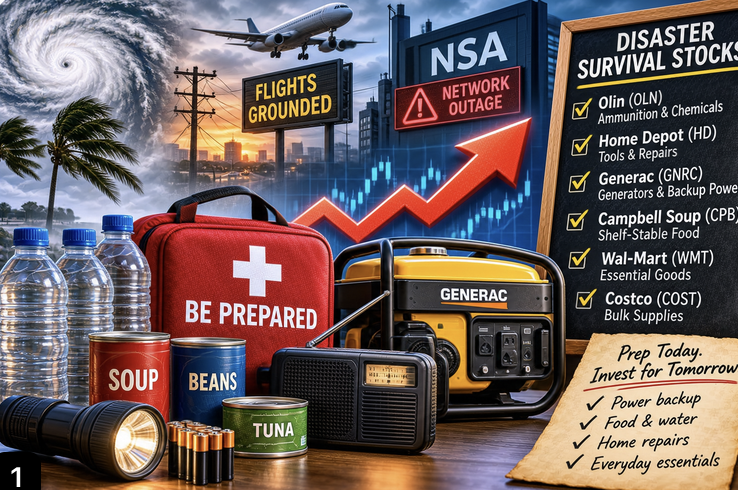
There is an investment theme that could be called disaster survival stocks. These are companies that manufacture or sell products people may want to have available when normal services are interrupted. They include generators, emergency supplies, canned food, bottled water, home improvement products, ammunition, and other necessities.
The recent events have also brought renewed attention to a group of people known as preppers.
The Prepper Movement Goes Mainstream
Preppers are people who take steps to prepare for emergencies, ranging from relatively ordinary situations such as hurricanes, earthquakes, and extended power outages to more extreme possibilities such as widespread infrastructure failures, economic disruptions, and societal breakdowns.
Traditional preppers often maintain supplies of food and water, backup electricity, first-aid equipment, emergency communications devices, and other necessities. Some have installed solar panels, battery storage systems, and generators. Others maintain gardens, preserve their own food, store fuel, and develop plans for living without conventional utilities.
What is particularly interesting is that emergency preparedness is no longer limited to people who consider themselves survivalists.
A November 19, 2026, Washington Post report described Americans buying emergency supplies following the recent outages. Purchases included bottled water, canned food, battery-powered radios, portable generators, solar power stations, and propane supplies. One consumer reportedly spent approximately $3,500 expanding his emergency inventory. The article also reported unusually strong interest in generators at Costco, with 21 of the 26 most expensive generators listed on its website sold out as of the preceding Sunday.
An additional report from Axios described a substantial increase in emergency-preparedness shopping, with one survival-gear retailer reporting a 450% increase in sales between October 27 and November 16 compared with preceding weeks.
Whether these developments represent a temporary reaction to the headlines or the beginning of a longer-term trend remains to be seen. However, they could create opportunities for companies that supply the products associated with emergency preparedness.
Here are six publicly traded companies that investors and traders may want to investigate.
1. Olin Corporation (NYSE: OLN)
A Chemicals and Ammunition Play
Emergency supplies exposure
NYSE: OLN
Olin is an interesting, somewhat unconventional disaster-preparedness investment because it operates two businesses that could be relevant during periods of heightened emergency preparedness. Its Winchester division manufactures ammunition, including products for recreational shooting, hunting, law enforcement, and military applications. Its other operations produce chemicals, including chlorine, caustic soda, and epoxy products.
Ammunition is an established component of the prepper market, particularly among individuals interested in hunting, personal protection, and self-sufficiency. Increased consumer interest in emergency preparedness could potentially support ammunition demand, although Winchester’s business is much broader than the prepper market.
Olin reported third-quarter 2026 sales of approximately $1.75 billion and net income of $14.4 million, compared with $42.8 million in the prior-year quarter. Adjusted EBITDA was $191.4 million, down from $222.4 million. The company is also pursuing a merger with Huntsman, which it expects to close in the first quarter of 2027, subject to regulatory approvals.
Investment consideration: Winchester provides an interesting angle on the preparedness theme, but investors should remember that Olin is primarily a cyclical chemical company. Its earnings are sensitive to industrial demand, energy costs, chemical prices, and operating conditions. Its substantial debt and proposed merger also deserve attention.
2. The Home Depot (NYSE: HD)
The Emergency Repair and Equipment Play
NYSE: HD
Home Depot is one of the more obvious companies that could benefit when homeowners decide they need to become more self-sufficient. The company sells generators, power tools, flashlights, batteries, building materials, plumbing supplies, electrical equipment, and other products that become particularly important when homes experience damage or utility interruptions.
After a hurricane, wildfire, earthquake, or extended power outage, homeowners frequently need equipment and materials to restore their properties. Portable generators, extension cords, chainsaws, tarps, water pumps, and electrical supplies can all experience increased demand.
Home Depot also benefits from longer-term trends that have little to do with disasters, including aging housing stock, remodeling, maintenance, and professional contractor spending.
The company reported fiscal third-quarter 2026 sales of $43.4 billion, up 4.9% from the prior-year quarter. Comparable-store sales increased 2.2%, while earnings were $3.72 per diluted share. Management projected approximately 4.5% full-year sales growth for fiscal 2026.
Investment consideration: Home Depot offers exposure to disaster-related repairs and preparedness without relying exclusively on emergency purchases. However, higher interest rates, weak housing turnover, and reduced consumer spending on remodeling could affect growth.
3. Generac Holdings (NYSE: GNRC)
The Backup Electricity Play
One of the most direct beneficiaries
NYSE: GNRC
Generac may be one of the most direct ways to invest in the disaster-preparedness trend. The company manufactures standby generators, portable generators, battery storage systems, and other energy technology products.
For homeowners, a standby generator can automatically provide electricity when the utility grid goes down. This can be particularly important for people who depend on electricity for medical equipment, refrigeration, heating, air conditioning, security systems, and communications.
The company also sells commercial and industrial backup power systems. Hospitals, data centers, telecommunications facilities, businesses, and other critical operations require dependable backup electricity.
An especially interesting development is the growing demand for backup power from data centers. Generac announced a long-term supply agreement with Amazon that includes an expected $2.4 billion in initial generator deliveries during 2027 and 2028.
Generac’s third-quarter 2026 results were impressive. Net sales increased 16% to a record $1.29 billion, while net income rose to $109 million from $66 million in the prior-year quarter. Residential sales increased approximately 9%, supported by stronger demand for home standby and portable generators. The company maintained its full-year sales growth guidance in the mid-to-high teens percentage range. Its data-center product backlog reached approximately $4.5 billion.
Investment consideration: Generac is particularly attractive as a way to participate in the longer-term need for backup electricity, including data-center demand. However, the stock can be sensitive to weather patterns, residential construction, interest rates, and the timing of generator purchases. Competition and execution risks associated with its expanding industrial business should also be considered.
4. The Campbell’s Company (NASDAQ: CPB)
The Shelf-Stable Food Play
NASDAQ: CPB
Food is one of the most basic components of emergency preparedness. When people worry about disruptions to grocery stores, transportation, or electricity, they often begin stocking their pantries with products that have long shelf lives.
Campbell’s is well positioned in this category through its soup, canned food, sauces, snacks, and other packaged food products. Its well-known brands include Campbell’s, Prego, Pace, Swanson, and Goldfish.
Canned soup and other shelf-stable foods are particularly useful during emergencies because they can be stored for extended periods and many varieties can be consumed with little preparation.
Unlike companies that sell generators or emergency equipment, Campbell’s has a business that is not dependent on consumers making large discretionary purchases. Food is something people need regardless of economic conditions.
However, investors should be aware that Campbell’s has recently encountered financial difficulties. For fiscal 2026, annual sales declined 5% to $9.7 billion, while adjusted earnings per share declined 27% to $2.17. The company announced a dividend reset as part of a strategy to accelerate debt reduction. It is also targeting $500 million in cost savings by fiscal 2030.
Investment consideration: Campbell’s offers defensive consumer staples exposure, but investors should not assume that increased emergency food purchases will automatically translate into substantial earnings growth. Competition, consumer preferences, food input costs, and the company’s debt reduction efforts are important considerations.
5. Walmart (NASDAQ: WMT)
The Essential Goods Distribution Play
NASDAQ: WMT
Walmart could be one of the biggest beneficiaries of increased consumer interest in emergency preparedness simply because of its enormous retail distribution network.
The company sells virtually everything consumers might need during an emergency, including bottled water, canned food, batteries, flashlights, first-aid supplies, over-the-counter medications, blankets, coolers, portable power equipment, and household necessities.
Its combination of physical stores, distribution centers, and e-commerce operations gives it an advantage in making essential products available to consumers. Walmart’s grocery business is particularly important because food represents a large portion of household emergency supplies.
There is also an important distinction between Walmart and some of the other companies discussed here. Walmart does not need a major disaster to generate sales. It sells everyday necessities that consumers purchase regularly, regardless of whether they are preparing for an emergency.
Walmart reported third-quarter fiscal 2027 revenue of $188.8 billion on November 19, 2026, an increase of 5.2%. E-commerce sales increased 17% globally, and the company raised its full-year outlook. Operating income increased 16%.
Investment consideration: Walmart offers a relatively diversified way to participate in the emergency-preparedness theme. Its scale, pricing power, and everyday grocery business provide some defensive characteristics. However, its valuation, labor costs, competitive pressures, and retail profit margins should be examined before purchasing shares.
6. Costco Wholesale (NASDAQ: COST)
The Bulk Purchasing and Stockpiling Play
Recent demand evidence
NASDAQ: COST
Costco might be one of the most interesting companies in this group because its warehouse business is naturally suited to consumers who want to purchase large quantities of essential goods.
Its merchandise includes bulk bottled water, canned food, paper products, batteries, first-aid supplies, household necessities, and emergency equipment. Costco also sells generators and other power-related products.
The membership warehouse model encourages consumers to buy larger quantities than they might purchase at a conventional grocery store. This is particularly attractive to households that want to maintain an emergency supply of food and other essentials.
There is already evidence that recent events have generated increased interest in Costco’s emergency-preparedness merchandise.
According to a November 2026 report citing Mizuho Securities, 21 of the 26 most expensive generators listed on Costco’s website were sold out as of November 15. Analysts also attributed some of the company’s stronger October comparable-store sales to emergency-preparedness purchases.
Costco reported fiscal 2026 annual sales of approximately $297.2 billion, up 10.1% from the previous year. Fourth-quarter net income increased to approximately $3.0 billion from $2.61 billion. Its October 2026 sales increased 12.6% to $24.5 billion.
Investment consideration: Costco has an attractive business model, recurring membership income, and a loyal customer base. It could benefit from increased stockpiling, but emergency purchases are only a small part of its overall business. Its valuation is also an important consideration. Investors should avoid assuming that a temporary surge in preparedness shopping justifies paying an excessive earnings multiple.
Other stocks worth investigating
The six companies above are not the only publicly traded businesses that could benefit from increased emergency preparedness.
| Company | Symbol | Potential opportunity |
|---|---|---|
| Tractor Supply | TSCO | Generators, propane, livestock supplies, tools, and ammunition |
| Energizer Holdings | ENR | Batteries and portable lighting |
| Kenvue | KVUE | First-aid and personal care products |
| Procter & Gamble | PG | Hygiene, cleaning, and household necessities |
| American Water Works | AWK | Essential water infrastructure |
| First Solar | FSLR | Solar energy infrastructure |
| Lowe’s | LOW | Generators, tools, building materials, and repair supplies |
These companies provide additional exposure to different aspects of emergency preparedness, from portable power and food production to water infrastructure and home repairs.
What Are the Biggest Investment Risks?
Although disaster preparedness is an interesting investment theme, investors should distinguish between a temporary increase in consumer purchases and a sustained change in spending behavior.
A major outage or natural disaster can produce a sudden increase in demand for generators, bottled water, canned food, batteries, and other supplies. However, consumers may already have purchased these products, reducing the need for repeat purchases.
For example, a household that buys a generator may not need another one for 10 or 15 years. Similarly, people who stock their pantries with canned goods may not need to replenish their supplies immediately.
There is also the risk that investors will overreact to headlines. A stock can rise substantially on expectations of higher demand even if the actual increase in company earnings is relatively small.
Valuation is especially important. Costco, for example, has a strong business, but its shares have historically commanded a premium valuation. Campbell’s has a more defensive food business, but its recent financial results illustrate that even companies selling essential products can experience declining earnings.
Finally, these companies are exposed to different economic forces. Olin is affected by industrial chemical demand, Generac by generator purchasing cycles and data-center investment, and Home Depot by the housing and remodeling markets.
Conclusion: Building a Disaster-Preparedness Investment Watchlist
The recent technology outages, airline disruptions, and NSA network incident have highlighted an important vulnerability of modern society: We depend on interconnected systems that can sometimes fail unexpectedly.
Whether these incidents prove to be isolated technical problems or part of a broader trend, they have reminded consumers of the importance of having backup plans.
From an investment perspective, I would put Generac near the top of the list because it provides direct exposure to backup electricity, a market that has opportunities beyond residential emergency preparedness, particularly with data centers. Home Depot is another interesting candidate because it sells the equipment and materials needed to prepare for and recover from disasters.
Walmart and Costco provide exposure to consumers stocking up on necessities, while Campbell’s offers exposure to shelf-stable food. Olin is a more specialized investment, with its Winchester ammunition business providing an additional angle on the preparedness market.
I would be particularly interested in monitoring whether the recent increase in emergency-preparedness shopping translates into sustained sales growth over the next several quarters. If consumers begin making preparedness a regular part of household budgeting rather than simply reacting to alarming headlines, some of these companies could benefit from a meaningful long-term business trend.
The key for investors and traders is not to bet on a disaster occurring. It is to identify companies that sell products people increasingly value because they want to be prepared if one does.
This article is for informational and investment research purposes only. It is not a recommendation to buy or sell any particular security. Investors should examine current valuations, earnings, balance sheets, and risk factors before making investment decisions. No investment recommendations are expressed or implied.