
by Fred Fuld III
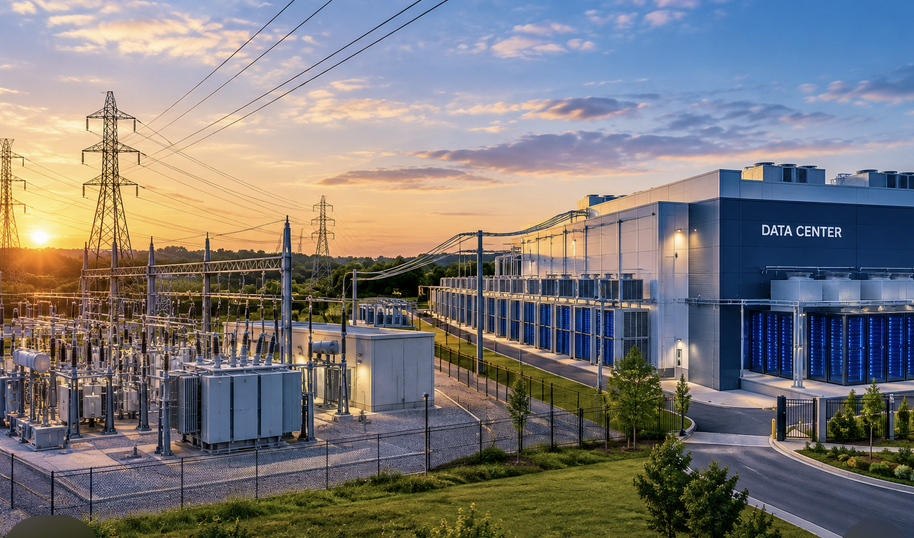
Here is an investment strategy for you: publicly traded regulated electric utilities that have large amounts of committed data-center load in their service territories and are allowed to earn a return on the generation, transmission and distribution infrastructure needed to serve that load.
That distinction is important. A state can be extremely friendly to data centers, but the economic benefit may accrue to a municipal utility, cooperative, independent power producer, or the data-center operator rather than a publicly traded utility.
The timing is particularly interesting. EPRI now estimates that U.S. data centers could consume 9%–17% of U.S. electricity by 2030, versus roughly 4%–5% today. Virginia is already the standout, with data centers consuming more than 20% of the state’s electricity. And just today, the EIA projected U.S. electricity consumption to hit records in both 2026 and 2027, with AI/data centers a major driver.
My preliminary ranking
| State | Planned DCs* | My view | Publicly traded utilities to investigate |
|---|---|---|---|
| Georgia | 141 | ⭐⭐⭐⭐⭐ | Southern (SO) / Georgia Power |
| Indiana | 54 | ⭐⭐⭐⭐⭐ | AES (AES), Duke Energy (DUK), NiSource (NI) |
| North Carolina | 41 | ⭐⭐⭐⭐⭐ | Duke Energy (DUK) |
| Virginia | 287 | ⭐⭐⭐⭐½ | Dominion Energy (D) |
| Ohio | 57 | ⭐⭐⭐⭐½ | AEP (AEP), FirstEnergy (FE) |
| Iowa | 41 | ⭐⭐⭐⭐ | Alliant Energy (LNT) |
| Arizona | 86 | ⭐⭐⭐⭐ | Pinnacle West (PNW) |
| Texas | 170 | ⭐⭐⭐½ | AEP, CenterPoint (CNP), Vistra (VST) |
| Pennsylvania | 51 | ⭐⭐⭐ | PPL (PPL), FirstEnergy, Exelon (EXC) |
| Illinois | 123 | ⭐⭐⭐ | Exelon (EXC), Ameren (AEE) |
*Pew’s “planned” category includes projects under construction, planned or land-banked. Virginia has 287, Texas 170, Georgia 141, Illinois 123, Arizona 86, Ohio 57, Indiana 54 and Pennsylvania 51.
But there is a very important development happening right now: the states that were most aggressive in attracting data centers are beginning to push back. So I wouldn’t use “tax incentives” as my primary measure of attractiveness anymore.
1. Georgia may be the most interesting state right now
This one jumps out to me.
Atlanta has actually overtaken Northern Virginia as the largest North American market for data-center construction, with 2,882 MW under construction in the first half of 2026. Northern Virginia remains the largest existing market, but Atlanta’s construction pipeline is remarkable.
The key utility is:
Southern Company (SO) → Georgia Power
Georgia Power is particularly interesting for your strategy because it has explicitly changed its rules so that large new customers such as data centers pay the costs associated with serving them. It can require longer contracts, minimum bills, financial security and termination payments, while large customers pay local infrastructure costs upfront.
That’s almost exactly what you want to see as an investor:
data center growth → electricity demand → infrastructure investment → rate base → earnings growth
without as much risk that existing residential customers end up subsidizing the data centers.
SO would be one of my first stocks to investigate.
2. Indiana is extremely interesting
Indiana is less obvious than Virginia or Texas, but I think it could turn out to be one of the better risk-adjusted opportunities.
EPRI specifically identifies Indiana as one of the states where data-center electricity consumption could exceed 20% of total electricity demand by 2030 in its medium scenario.
And Indiana has done something particularly interesting from an investor perspective.
AES Indiana → AES (AES)
AES has a proposed Google data center in Indiana under a 15-year customer-specific contract. Google would pay 100% of the power costs and 100% of the new infrastructure required for the facility. AES says the arrangement could generate more than $770 million in fixed-cost savings for existing customers over 15 years.
That’s a very attractive model.
You’re not merely betting that “AI will use lots of electricity.”
You’re betting on:
AI load + regulated utility + long-term contract + customer-funded infrastructure + rate-base investment.
That’s a much better investment thesis.
3. North Carolina — Duke Energy
I’d put Duke Energy (DUK) high on the list.
North Carolina has 41 planned data centers according to the Pew/Data Center Map data, and Duke is directly positioning itself for the load growth.
Duke recently said that data-center growth should produce billions of dollars in customer benefits, with new revenues supporting grid investment and additional energy resources.
Duke is also developing a framework designed to make sure data centers pay their fair share of the infrastructure costs.
This makes DUK interesting because you get exposure to North Carolina and South Carolina, rather than having to make a single-state bet.
4. Virginia — the biggest opportunity, but also the biggest political risk
This is the obvious one.
Virginia has 287 planned data centers, versus 141 in Georgia and 170 in Texas. It already has the largest data-center concentration in the world.
The obvious utility is:
Dominion Energy (D)
The economics are spectacular. EPRI projects Virginia’s data centers could represent 39%–57% of the state’s electricity demand by 2030 under its scenarios.
But there is a catch.
Virginia has become a political battleground over data centers. Dominion’s fuel costs have risen sharply as it has had to purchase more electricity from the PJM wholesale market, and regulators and politicians are increasingly concerned about the effect on residential customers. The Virginia SCC has nevertheless implemented protections that are actually quite favorable from an investment perspective: data centers must sign contracts of at least 14 years, pay at least 85% of transmission/distribution costs regardless of usage, and may have to provide collateral covering up to 60% of minimum charges.
So I would not eliminate Dominion because of the backlash.
I’d view it as:
Huge data-center opportunity + huge rate-base opportunity + increasing political risk.
That’s a fascinating investment setup.
5. Ohio — particularly interesting because of AEP
Ohio is another one I’d investigate closely.
AEP (AEP) has created a specific Data Center Tariff.
This is particularly revealing: as of February 2026, AEP Ohio had signed binding contracts representing 5,642 MW of data-center load, in addition to 12,219 MW of contracts signed before the tariff took effect.
That’s an enormous amount of potential load.
And AEP’s tariff is designed so that the data centers bear the infrastructure costs rather than existing customers.
That’s precisely the sort of information I would want in an investment screen.
The complication is that Ohio has recently begun reconsidering its extremely generous data-center incentives. The state paused new applications, and the broader political backlash is growing.
But here’s the interesting part:
AEP doesn’t necessarily need Ohio to give data centers huge tax breaks.
AEP needs the data centers to actually connect to its grid and consume electricity.
That’s a different thesis.
6. Iowa — the sleeper
I think Iowa deserves more attention than it gets.
EPRI identifies Iowa as one of the states where data centers could account for an unusually large percentage of electricity consumption. Iowa also has an unusually explicit data-center incentive structure. Qualified data centers can receive sales/use tax benefits on electricity, equipment, cooling systems, power infrastructure, backup generation and batteries, subject to investment requirements.
The utilities I’d investigate are:
Alliant Energy (LNT)
MidAmerican Energy — privately held subsidiary of Berkshire Hathaway, so not useful for your publicly traded utility strategy.
That makes LNT the obvious stock to investigate.
The downside is that Iowa’s absolute data-center market is considerably smaller than Virginia, Texas or Georgia.
7. Arizona — another interesting growth market
Arizona has 86 planned data centers, according to the Pew data.
The obvious stock is:
Pinnacle West (PNW) → Arizona Public Service
What’s particularly interesting is that APS is now explicitly saying:
“Growth should pay for growth.”
APS says data centers and other very large customers should pay the infrastructure costs required to serve them, rather than shifting those costs to existing customers.
That’s exactly the kind of regulatory environment I’d like to see.
The problem is that Arizona is also becoming politically more cautious about data-center development, so I’d put it below Georgia/Indiana/North Carolina.
What about Texas?
Texas is almost a separate category.
It has 170 planned data centers, and Texas is one of the biggest electricity-growth stories in the country.
Potential stocks include:
AEP
CenterPoint Energy (CNP)
Vistra (VST)
But I would be careful.
Texas is currently experiencing a significant political backlash against data centers. Governor Abbott has moved toward greater restrictions, and new data-center grid connections have faced delays.
That doesn’t mean Texas data centers aren’t going to happen. Far from it. But it makes Texas a higher-risk, higher-opportunity component of this strategy.
There’s another important distinction: Texas’s ERCOT market is different from the traditional regulated utility model. Consequently, the relationship between data-center electricity demand and a utility’s regulated rate base isn’t as straightforward as it is with Dominion, Southern, Duke or AEP Ohio.
The investment strategy I would actually build
I would not buy utilities simply because they are located in states that are friendly to data centers.
I’d create a five-factor screen:
1. Data-center pipeline
How many MW of data-center projects are actually planned or contracted?
This is more important than simply counting facilities.
A single 1,000-MW AI campus can be more important to a utility than dozens of conventional data centers.
2. Utility ownership
Does a publicly traded utility actually serve the data center?
This eliminates a surprising number of apparent opportunities.
3. Regulatory structure
This may be the most important factor.
You want to see:
Data center → pays utility → utility builds infrastructure → infrastructure enters rate base → utility earns regulated return.
The Indiana/AES and Ohio/AEP models are particularly interesting examples.
4. Contract duration
I’d favor utilities where data centers have signed 10-, 15- or 20-year commitments rather than merely having “announced plans.”
A proposed data center isn’t worth nearly as much as a signed 15-year power contract.
5. Generation and transmission investment
This is where the strategy becomes much more interesting.
A 500-MW data center doesn’t just buy 500 MW of electricity.
The utility may have to build:
- substations
- transmission lines
- natural-gas generation
- nuclear capacity
- solar
- batteries
- transformers
- distribution infrastructure
If those investments are included in rate base, the data center can effectively become a catalyst for years of utility capital expenditures.
My preliminary “data-center utility” watch list
If I were constructing a portfolio around this theme today, my first group to research would be:
SO — Southern Company / Georgia Power
DUK — Duke Energy
AEP — American Electric Power
D — Dominion Energy
AES — AES Corporation
PNW — Pinnacle West
LNT — Alliant Energy
I’d put CNP, FE, NI, PPL and EXC in a second group.
And I would treat VST differently because its exposure is more tied to competitive power generation rather than the classic regulated-utility rate-base story.
One particularly interesting conclusion
The idea may actually be better than a simple “buy utilities in data-center states” strategy.
The more sophisticated version is:
Find utilities where hyperscale/AI data centers are forcing large, contracted, customer-funded additions to regulated generation and transmission infrastructure.
That could give you a way to identify utilities before the full earnings impact appears in the financial statements.
Disclosure: Author didn’t own any of the above at the time the article was written. No investment recommendations are expressed or implied.