This Day Today in Business & Investment History

by Fred Fuld III

Apple Computer (AAPL) was incorporated in 1977.

The first block of the blockchain of the decentralized payment system Bitcoin, called the Genesis block, is established by the creator of the system in 2009.

The Bell Telephone Company (T) was chartered in Massachusetts by Alexander Graham Bell and his associates in 1876.

The Bank of Italy changes its name to Bank of America National Trust and Savings Association (BAC), solidifying its national expansion beyond its Californian roots in 1928.

IBM Corporation (IBM) introduces the IBM 1401, a pioneering transistorized computer designed for business applications in 1960.

The New York Stock Exchange introduces the Decimalization Plan, shifting stock prices from fractions to whole dollar amounts in 1970.

Sony Corporation (SONY) releases the Sony Walkman TPS-L2, the first commercially successful portable cassette player in 1981.

Taylor Swift is Still Outperforming the Stock Market

by Fred Fuld III

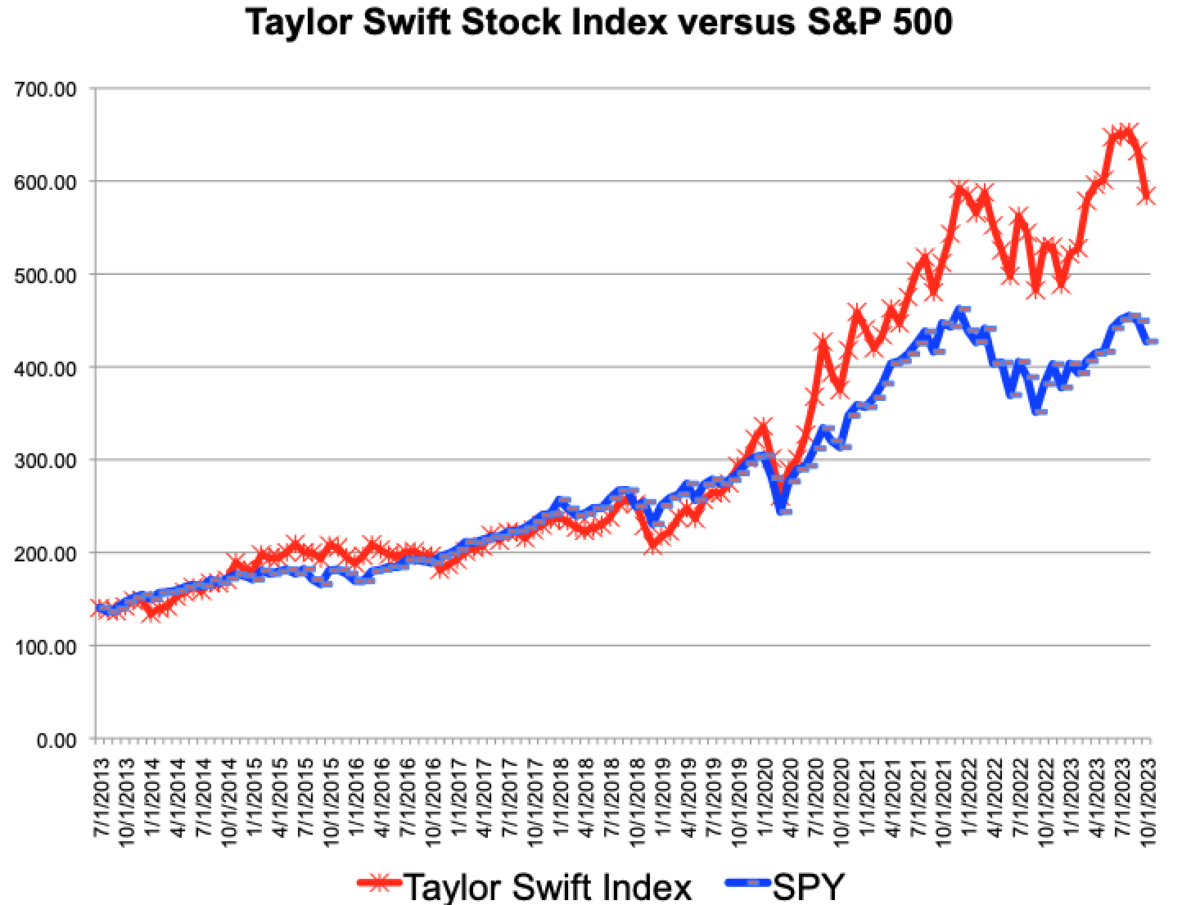
A few months ago, I wrote an article called Taylor Swift Stock Index outperforms the S&P 500. In spite of the market dropping, Taylor Swift related stocks are still outperforming the stock market.

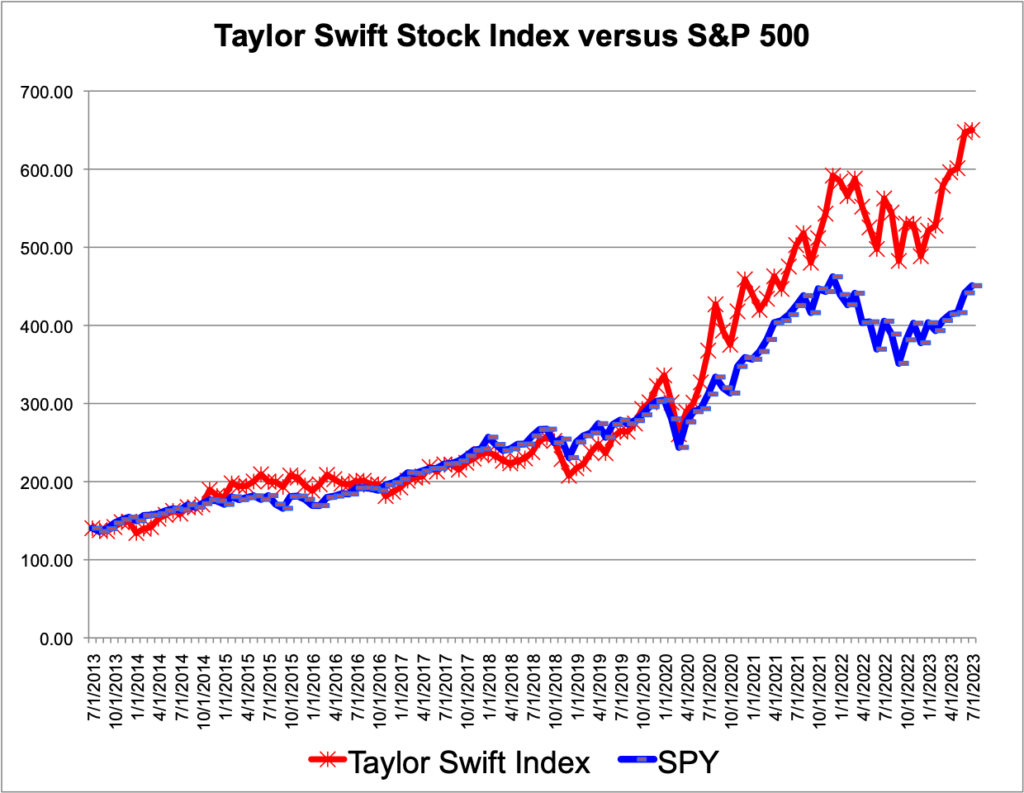
Her Stock Index is up more than 315% over the last ten years versus 20% for the S&P 500.

Taylor Swift is not only beautiful and a great singer, songwriter, and actress, she is also very intelligent, especially in the area of finance.

Did you know that she almost became a celebrity spokesperson for FTX, the cryptocurrency company that was involved in a scandal that involved the arrest of the founder for fraud charges.

Taylor Swift was reportedly offered a $100 million sponsorship deal with the FTX cryptocurrency exchange. However, she ultimately declined the deal after asking FTX representatives a simple question: “Can you tell me that these are not unregistered securities?”

This question was significant because it raised the issue of whether FTX was selling unregistered securities. Unregistered securities are a type of investment that is not registered with the Securities and Exchange Commission. This means that investors in unregistered securities do not have the same level of protection as investors in registered securities.

Swift’s question about unregistered securities appears to have been a dealbreaker for FTX.

In addition to asking about unregistered securities, Swift reportedly also did her own research on FTX before deciding to decline the sponsorship deal. She reportedly read the company’s white paper and spoke to other celebrities who had been involved with FTX.

Unfortunately for those other celebrities, which included Tom Brady, Gisele Bündchen, Steph Curry, Naomi Osaka, David Ortiz, Shaquille O’Neal, Kevin O’Leary, and Larry David, they got caught up in the scandal.

These celebrities appeared in paid advertising campaigns for FTX and promoted the exchange on social media.

In December 2022, a class-action lawsuit was filed against FTX and its celebrity endorsers. The lawsuit alleges that the celebrities engaged in deceptive practices to sell FTX yield-bearing digital currency accounts.

Taylor Swift, as a prominent figure in the entertainment industry, has been sought after by various brands for celebrity endorsements. Three notable endorsements in her career include Coca-Cola’s (KO) Diet Coke, Apple (AAPL), and Coty (COTY).

Swift signed a multi-year partnership with Diet Coke in 2013. She became the face of their brand and appeared in commercials and print advertisements. The collaboration aimed to promote the brand’s message of positivity and refreshment. Swift’s bubbly personality and wide fan base made her an ideal ambassador for Diet Coke, and her endorsement helped raise brand awareness and reach a younger demographic.

In 2015, Swift teamed up with Apple for an exclusive endorsement deal. It started with a public disagreement when Swift criticized Apple Music’s initial policy of not compensating artists during the service’s three-month free trial period. After Apple changed its policy, Swift became an advocate for the platform and released her album “1989” exclusively on Apple Music. She also appeared in commercials and promotional materials for the streaming service, showcasing her influence in the music industry and helping Apple Music gain popularity among her dedicated fanbase.

Coty, a major beauty and fragrance company for the CoverGirl cosmetics brand, partnered with Taylor Swift in 2010 to launch to launch NatureLuxe makeup. The partnership with Coty allowed Swift to expand her brand beyond music into the lucrative world of celebrity fragrances.

These endorsements showcase Taylor Swift’s ability to align herself with influential brands and effectively promote their products. Her partnerships have not only enhanced her public image but have also allowed her to diversify her portfolio and extend her brand beyond the music industry.

I have developed stock indices for many celebrities, such as Gisele Bündchen, which I originally created back in 2007.

Because of Swift’s astute review of endorsements, I thought it would be interesting to see how the stocks of the major companies that she endorsed have done over time, compared to the S&P 500, as measured by the SPY ETF.

She was in the Got Milk? campaign, but obviously, the California Milk Processor Board is not a publicly traded stock. She also promoted L.E.I. Jeans, a brand owned by Nine West Holdings, a privately held company.

So I stuck with the three major companies that she was connected with, Coca-Cola, Apple, and Coty.

What are the results?

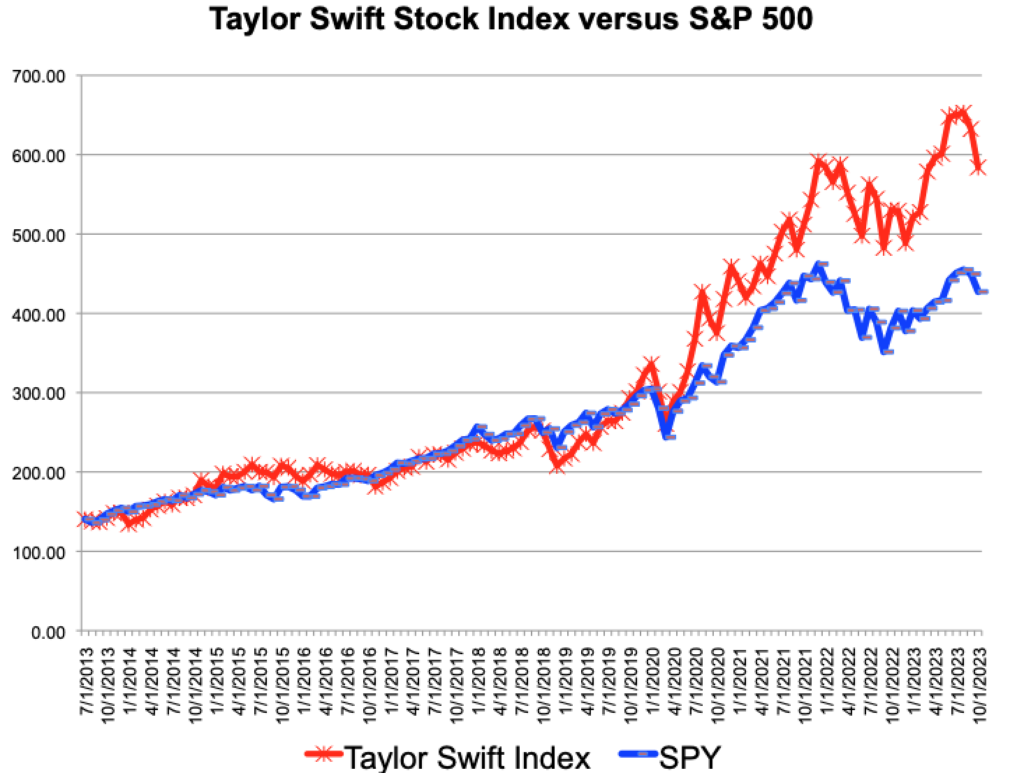
I ran the analysis over a ten year period, from July 1, 2013 to July of this year. Over that period of time, the Taylor Swift Stock Index outperformed the S&P 500 by a very substantial amount.

Taylor Swift was up 362.95% versus the SPY, which was up only 221.04%. Just look at the chart to see the difference.

Data Source: Yahoo! Finance: Historical Prices

Maybe one of these stocks is singing your song.

Prices are beginning of month first trading day close, adjusted for splits, dividends, and capital gains distributions. The Taylor Swift Index is a price-weighted index, similar to the Dow Jones Industrial Average.

Disclosure: Author owns AAPL.

Investing in Gargling? The Scoop on Entertainment & Other Royalty Investments!

by Fred Fuld III

Have you ever thought about owning the rights to music from your favorite band? Or maybe you would like to own the residuals from a movie you like. Maybe even investing in trademarks.

Recently, investors had the opportunity to own the right to royalties from Listerine. Yes, the mouthwash you use to gargle with. Yup, every time someone uses Listerine and spits it out, the investor would make money.

This investment was available through an organization called the Royalty Exchange. Investors could make an offer on what they would pay for receiving a flat rate royalty on worldwide Listerine sales, for as long as Listerine is sold. Listerine has been providing royalties for 142 years. 

Royalties are paid monthly and Listerine has paid $12,507 during the last twelve months.

What other things can you invest in? The music from the film Shrek, royalties from standardized tests, Apple (AAPL) alert tone royalties, and tracks of music from Enrique Iglesias and Rihanna.

Previous transactions that the company handled include royalties from Coldplay and Beyonce, Jerry Garcia’s Cherry Garcia Trademark Royalties, and Naked & Afraid TV placements.

I want to point out that these investments do have some risk, like any investments. Second, I am not recommending any of these investments; I’m only mentioning them for you to do your own due diligence. Third, I have no connection to the Royalty Exchange whatsoever. 

So what is the Royalty Exchange?

Royalty Exchange is an online marketplace that facilitates the buying and selling of royalties and intellectual property rights. It allows creators, artists, and copyright holders to monetize their intellectual property by selling a portion of their future royalties to investors. Here’s a general profile of Royalty Exchange:

Business Model and Purpose:

  • Royalty Exchange serves as a platform connecting creators of intellectual property (such as musicians, songwriters, authors, and other content creators) with investors interested in purchasing a share of their future royalties.
  • The platform allows creators to access immediate capital by selling a portion of their royalty income, often in exchange for a lump sum payment.

Types of Intellectual Property:

  • Royalty Exchange deals with a wide range of intellectual property, including music royalties, book royalties, film and TV show royalties, patent royalties, and more.
  • Music royalties are one of the most prominent categories on the platform. This includes royalties from songwriting, publishing, performance, and mechanical rights.

How It Works:

  1. Creators looking for funding list their intellectual property rights on the Royalty Exchange platform.
  2. Investors browse the available opportunities and can place bids on the rights they’re interested in purchasing.
  3. A competitive bidding process takes place, and the highest bidder wins the right to receive a portion of the future royalties.
  4. The creator receives an upfront payment, and the investor receives a share of the royalties generated by the intellectual property over time.

Benefits:

  • Creators can access immediate funding without taking on debt or selling ownership of their intellectual property outright.
  • Investors can diversify their portfolios by investing in various types of intellectual property.
  • The platform aims to create a win-win situation by allowing creators to unlock value from their royalties while providing investors with potential long-term income streams.

Marketplace Transparency:

  • Royalty Exchange aims to provide transparency by providing data and analytics related to the performance of the intellectual property being offered for sale.

The advantage of royalty trusts include the fact that they are uncorrelated assets, they have the potential to provide high yields, and offer passive income.

One thing you should be aware of is the time frame of the investment. The company provides these definitions:

  • Term Based: Investor collects royalty income for a fixed period of time (typically 10 years). Royalty income then reverts to the original seller after the end of the term.
  • Life of Rights: Investor collects royalty income for the length of the underlying copyright (Lifetime of the creator PLUS 70 years).

A Publicly Traded Entertainment Royalty Trust

If the Royalty Exchange investments are too rich for your blood, you could also consider Mills Music Trust (MMTRS), which is a publicly traded stock that trades Over-the-Counter.  It receives income from royalties from the music catalog of EMI Mills Music Inc. 

The catalogue is estimated to be composed of over 12,000 music titles, of which approximately 1,430 have produced royalty income in recent years. Some of the top songs include: 

  • Little Drummer Boy
  • Sleigh Ride
  • Star Dust
  • It Don’t Mean A Thing
  • Mood Indigo
  • I’ve Got the World On A String
  • Ain’t Misbehavin’
  • Lovesick Blues
  • Hold Me, Thrill Me, Kiss Me
  • Stormy Weather
  • Red Roses for a Blue Lady

This New York based trust was founded in 1964. It pays a dividend of 8.3%, and has very low trading volume, with a wide spread between the bid and ask prices. At one time, Paul McCartney was a major shareholder of the company.

Because it is a trust, it avoids the double taxation of corporations. There may be personal tax benefits to the investor; talk to your accountant about it.

Buying royalties is a quick way of getting into show business, but it carries a lot of risk.

Disclosure: Author owns MMTRS. Author and this site have no connection to Royalty Exchange, has not done due diligence on the company, and are not recommending the company or its royalty investments. No investments are expressed or implied. All investors should do their own due diligence.

Taylor Swift Stock Index Outperforms the S&P 500

by Fred Fuld III

Taylor Swift is not only beautiful and a great singer, songwriter, and actress, she is also very intelligent, especially in the area of finance.

Did you know that she almost became a celebrity spokesperson for FTX, the cryptocurrency company that was involved in a scandal that involved the arrest of the founder for fraud charges.

Taylor Swift was reportedly offered a $100 million sponsorship deal with the FTX cryptocurrency exchange. However, she ultimately declined the deal after asking FTX representatives a simple question: “Can you tell me that these are not unregistered securities?”

This question was significant because it raised the issue of whether FTX was selling unregistered securities. Unregistered securities are a type of investment that is not registered with the Securities and Exchange Commission. This means that investors in unregistered securities do not have the same level of protection as investors in registered securities.

Swift’s question about unregistered securities appears to have been a dealbreaker for FTX.

In addition to asking about unregistered securities, Swift reportedly also did her own research on FTX before deciding to decline the sponsorship deal. She reportedly read the company’s white paper and spoke to other celebrities who had been involved with FTX.

Unfortunately for those other celebrities, which included Tom Brady, Gisele Bündchen, Steph Curry, Naomi Osaka, David Ortiz, Shaquille O’Neal, Kevin O’Leary, and Larry David, they got caught up in the scandal.

These celebrities appeared in paid advertising campaigns for FTX and promoted the exchange on social media.

In December 2022, a class-action lawsuit was filed against FTX and its celebrity endorsers. The lawsuit alleges that the celebrities engaged in deceptive practices to sell FTX yield-bearing digital currency accounts.

Taylor Swift, as a prominent figure in the entertainment industry, has been sought after by various brands for celebrity endorsements. Three notable endorsements in her career include Coca-Cola’s (KO) Diet Coke, Apple (AAPL), and Coty (COTY).

Swift signed a multi-year partnership with Diet Coke in 2013. She became the face of their brand and appeared in commercials and print advertisements. The collaboration aimed to promote the brand’s message of positivity and refreshment. Swift’s bubbly personality and wide fan base made her an ideal ambassador for Diet Coke, and her endorsement helped raise brand awareness and reach a younger demographic.

In 2015, Swift teamed up with Apple for an exclusive endorsement deal. It started with a public disagreement when Swift criticized Apple Music’s initial policy of not compensating artists during the service’s three-month free trial period. After Apple changed its policy, Swift became an advocate for the platform and released her album “1989” exclusively on Apple Music. She also appeared in commercials and promotional materials for the streaming service, showcasing her influence in the music industry and helping Apple Music gain popularity among her dedicated fanbase.

Coty, a major beauty and fragrance company for the CoverGirl cosmetics brand, partnered with Taylor Swift in 2010 to launch to launch NatureLuxe makeup. The partnership with Coty allowed Swift to expand her brand beyond music into the lucrative world of celebrity fragrances.

These endorsements showcase Taylor Swift’s ability to align herself with influential brands and effectively promote their products. Her partnerships have not only enhanced her public image but have also allowed her to diversify her portfolio and extend her brand beyond the music industry.

I have developed stock indices for many celebrities, such as Gisele Bündchen, which I originally created back in 2007.

Because of Swift’s astute review of endorsements, I thought it would be interesting to see how the stocks of the major companies that she endorsed have done over time, compared to the S&P 500, as measured by the SPY ETF.

She was in the Got Milk? campaign, but obviously, the California Milk Processor Board is not a publicly traded stock. She also promoted L.E.I. Jeans, a brand owned by Nine West Holdings, a privately held company.

So I stuck with the three major companies that she was connected with, Coca-Cola, Apple, and Coty.

What are the results?

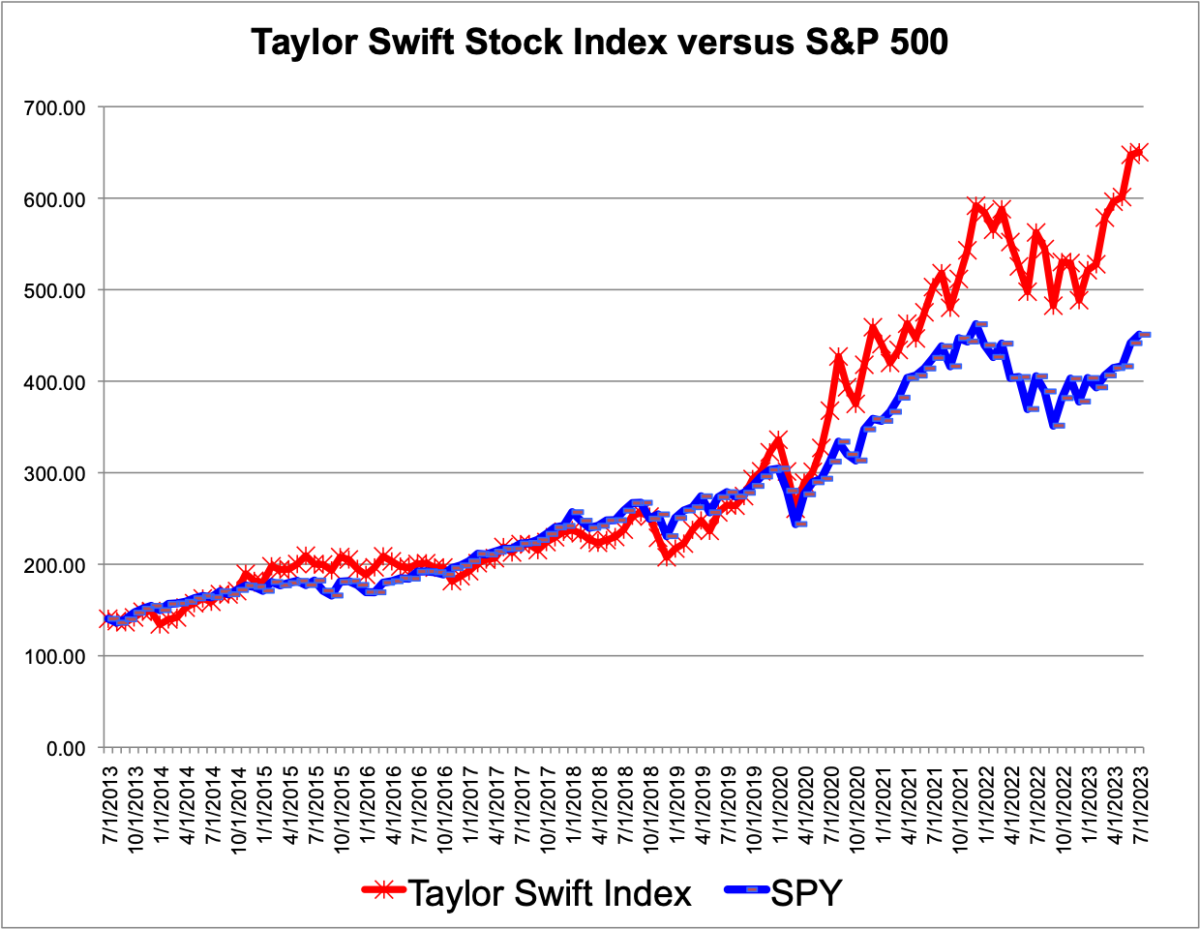
I ran the analysis over a ten year period, from July 1, 2013 to July of this year. Over that period of time, the Taylor Swift Stock Index outperformed the S&P 500 by a very substantial amount.

Taylor Swift was up 362.95% versus the SPY, which was up only 221.04%. Just look at the chart to see the difference.

Data Source: Yahoo! Finance: Historical Prices

Maybe one of these stocks is singing your song.

Prices are beginning of month first trading day close, adjusted for splits, dividends, and capital gains distributions. The Taylor Swift Index is a price-weighted index, similar to the Dow Jones Industrial Average.

Disclosure: Author owns AAPL.

Top 5 Pure Play AI Stocks

By Fred Fuld III

You’ve seen it on TV, you’ve read about it on news websites. Artificial Intelligence, commonly referred to as AI, is now the hottest industry. Stocks that are involved in this industry are taking off.

I originally wrote about a form of artificial intelligence back in October of 2021 in an article called The Future of Artificial Intelligence: Can You Invest In It Now?

So you may be wondering what companies are the purest plays.

WHAT AI IS

Artificial Intelligence, or AI for short, refers to the ability of machines to perform tasks that typically require human intelligence, such as learning, reasoning, problem solving, and decision-making. AI algorithms are designed to analyze data, recognize patterns, and make predictions or recommendations based on that analysis.

In other words, AI is a way to teach machines to perform tasks that would normally require human intelligence, and to improve their performance over time based on the data they analyze. This technology has the potential to revolutionize many aspects of our lives, from healthcare to transportation to entertainment. AI is even being used to write articles and books.

WHAT CHAT AI IS

One of the most popular types of AI services is Chat AI. 

Chat AI refers to the use of artificial intelligence technologies, such as natural language processing (NLP) and machine learning, to enable machines to communicate with humans via chat interfaces, such as chatbots or virtual assistants.

Chat AI is used in a variety of settings, such as customer service, where chatbots can be used to answer frequently asked questions, provide information, or help customers troubleshoot issues. Chat AI can also be used in healthcare to provide personalized support and advice, in education to assist with learning, and in business to streamline operations and improve customer engagement.

The key advantage of Chat AI is that it enables organizations to provide 24/7 support to their customers, without the need for human intervention. Additionally, Chat AI can help organizations save costs by automating routine tasks and reducing the need for human labor.

To enable effective Chat AI, developers must ensure that the algorithms are capable of understanding and interpreting natural language, as well as providing appropriate responses to user queries. This requires a combination of NLP and machine learning techniques, as well as ongoing training and improvement of the chat AI system.

Overall, Chat AI is an increasingly popular technology that has the potential to transform the way we interact with machines and automate routine tasks in various industries.

CREATING IMAGES WITH AI

Yes, artificial intelligence is now being used to create images, such as book covers, logos, album covers, and many other purposes. You just need to type in a simple description, and a picture will automatically be created. One of the most popular AI image services is called DALL-E.

DALL-E is an artificial intelligence system developed by OpenAI that is capable of generating images from textual descriptions. The name “DALL-E” is a combination of the artist Salvador Dali and the Pixar character Wall-E.

The DALL-E system uses a combination of machine learning techniques, including natural language processing and computer vision, to interpret textual descriptions and generate corresponding images. It is capable of creating images of objects and scenes that do not exist in the real world, such as a teapot made of giraffe or a snail-shaped harp.

THE BIG PLAYERS

The DALL-E system was trained on a dataset of text-image pairs, which enabled it to learn the relationship between textual descriptions and their corresponding visual representations. The system was trained on a massive amount of data, including images from the internet and text descriptions from a variety of sources.

The potential applications of DALL-E are numerous, including in the fields of art, design, and advertising. It has the potential to streamline the creative process and help artists and designers bring their ideas to life more quickly and easily. However, there are also concerns about the potential misuse of this technology, such as the creation of fake images or the propagation of harmful stereotypes.

First, let’s get the large stocks out of the way. There are many companies involved in AI, ranging from startups to large corporations. However, some of the biggest companies involved in AI are:

Google (GOOG) (GOOGL) is known for its search engine, but it’s also heavily invested in AI, with products like Google Assistant, Google Photos, and Google Translate all utilizing machine learning.

Amazon (AMZN) is using AI in many areas, such as its recommendation engine, its Alexa voice assistant, and its Amazon Go stores, which use computer vision to enable a checkout-free shopping experience.

Microsoft (MSFT) has been investing heavily in AI and has developed several AI-powered products, including Cortana, Skype Translator, and Microsoft Cognitive Services.

IBM (IBM) has a long history of developing AI technologies, and its Watson platform is one of the most well-known examples of AI in action.

Meta/Facebook (META) uses AI in a variety of ways, including facial recognition technology for tagging photos and content moderation.

Apple (AAPL) has been incorporating AI into many of its products, including Siri and Face ID.

NVIDIA (NVDA) is a leading manufacturer of GPUs, which are essential for training and running AI models.

Baidu (BIDU) is a Chinese search engine that is heavily investing in AI, with projects ranging from self-driving cars to voice recognition.

Tesla (TSLA) is using AI in its autonomous driving technology and is working to develop a fully self-driving car.

Alibaba (BABA), the Chinese e-commerce company, is investing in AI to improve its recommendation engine and other areas of its business.

THE PURE PLAYS

Now let’s get to the purer plays in artificial intelligence.

C3.AI

C3.ai, Inc. (AI) is a software company, located in Redwood City, California, that provides enterprise AI solutions for a variety of industries, including energy, healthcare, and finance. The company was founded in 2009 by Dr. Thomas M. Siebel, who is also the CEO of the company.

Before founding C3.ai, Dr. Siebel was the founder and CEO of Siebel Systems, a leading enterprise software company that was acquired by Oracle Corporation in 2006. After the acquisition, Dr. Siebel focused on developing AI-based solutions for the enterprise market and founded C3.ai.

Initially, C3.ai focused on developing predictive maintenance and energy management solutions for the energy industry. The company’s first product, C3 Energy Management, was designed to help utilities optimize their energy generation and distribution systems using machine learning algorithms.

Over time, C3.ai expanded its focus to other industries, including healthcare, financial services, and manufacturing. The company’s current product offerings include C3 AI Suite, which is a platform that enables organizations to develop and deploy AI applications, and C3.ai Ex Machina, which is an AI-powered data science platform for data scientists and developers.

C3.ai has received funding from several prominent investors, including Breyer Capital, TPG Growth, and the Rise Fund. In December 2020, the company went public on the New York Stock Exchange under the ticker symbol “AI,” raising $651 million in its initial public offering.

The stock has a market capitalization of $2.45 billion. This debt-free company has $6.76 in cash per share.

SOUNDHOUND AI

SoundHound AI, Inc. (SOUN) is a Silicon Valley-based technology company that specializes in developing sound recognition and voice-enabled AI solutions. The company was founded in 2005 by Dr. Keyvan Mohajer, who is also the CEO of the company.

Initially, the company started as a music recognition app called “Midomi,” which allowed users to hum or sing a song, and the app would identify the song. Later on, the company expanded its focus to voice-enabled AI technology and changed its name to SoundHound Inc.

In 2015, SoundHound Inc. launched its flagship product, Hound, which is an AI-powered voice assistant. Hound uses a natural language processing (NLP) technology that enables users to speak complex and specific queries in a conversational manner. The Hound voice assistant is available as a mobile app and can be integrated into other devices and applications.

In addition to Hound, SoundHound AI, Inc. also offers a suite of AI-based products and services, including sound recognition technologies for speech-to-text and music identification, and voice-enabled AI solutions for automotive, hospitality, and other industries.

The company has received funding from several prominent investors, including NVIDIA, Samsung, and Tencent Holdings. By 2021, SoundHound AI, Inc. had raised over $250 million in funding.

SoundHound has a market cap of $580 million. The company is debt-free and quarterly sales increased by over 79% year-over-year.

BIGBEAR.AI

BigBear.ai Holdings, Inc. (BBAI) is a technology company that develops and provides artificial intelligence (AI) solutions for defense and intelligence organizations, as well as for commercial customers. The company was founded in 2018 and is headquartered in Reston, Virginia.

BigBear.ai’s technology solutions use AI and machine learning to help customers make sense of large and complex data sets, as well as to automate decision-making processes. The company’s AI-driven solutions are designed to improve situational awareness, increase operational efficiency, and support decision-making across a range of industries and applications.

The company’s solutions cover a range of capabilities, including computer vision, natural language processing, and data analytics. BigBear.ai’s solutions are used in a variety of applications, such as intelligence analysis, threat detection, predictive maintenance, and supply chain optimization.

BigBear.ai has a broad customer base that includes government agencies and commercial customers in various industries. The company has received funding from several venture capital firms, including Riverside Partners, Chart National, and Blu Venture Investors.

In 2021, BigBear.ai announced that it had entered into a definitive agreement to merge with GigCapital4, a special purpose acquisition company (SPAC), in a deal that valued the combined company at $1.57 billion. The merger was completed in August 2021, and the combined company is now publicly traded on the NASDAQ under the ticker symbol “BBAI” as “BigBear.ai”.

This debt-free company has a market cap of $458 million. 

T STAMP

T Stamp Inc. (IDAI) is an identity authentication software company that uses artificial intelligence (AI) to develop solutions for government, enterprise partners, and peer-to-peer markets in the United States, the United Kingdom, and Malta.

T Stamp’s AI-powered solutions leverage biometric science, cryptography, and data mining to deliver identity and trust predictions, protect sensitive user information, and extend the reach of digital services through global accessibility. The company’s solutions include converting biometric and other identifying data into an Irreversibly Transformed Identity Token that serves as a secure tokenized identity. T Stamp also offers solutions for privacy and data protection, document validation, identity verification, geolocation, duplicate detection, and biometric capture.

T Stamp’s solutions serve a variety of industries, including banking/fintech, humanitarian and development services, KYC/AML compliance, government and law enforcement, P2P transactions, social media, and sharing economy, and real estate, travel, and healthcare. The company was incorporated in 2016 and is headquartered in Atlanta, Georgia.

Overall, T Stamp’s mission is to provide secure and scalable identity authentication solutions that leverage AI and advanced technologies to protect user privacy and combat identity fraud.

This is a microcap stock with an extremely low market cap of $18 million, and should therefore be considered extremely speculative. 

MARPAI

Marpai, Inc. (MRAI) is a software company that specializes in developing and deploying artificial intelligence (AI) systems for the enterprise market. The company was founded in 2016 by a team of experienced entrepreneurs and AI researchers, including CEO and Co-founder Mark Sears.

Marpai’s platform, called “Cortex,” is designed to help businesses leverage AI to automate processes, extract insights from data, and improve decision-making. Cortex uses advanced machine learning algorithms to analyze large amounts of data and provide actionable insights to users.

The company has received funding from prominent venture capital firms, including Bain Capital Ventures, Crosslink Capital, and SVB Capital, among others. In May 2021, Marpai announced that it had raised $30 million in a Series A funding round led by M12, Microsoft’s venture fund, with participation from other investors.

Marpai has a range of customers across different industries, including finance, healthcare, and retail. The company’s solutions are used for a variety of applications, such as fraud detection, customer service automation, and supply chain optimization.

Overall, Marpai’s mission is to democratize AI and make it more accessible to businesses of all sizes, by providing a scalable and user-friendly platform for deploying AI solutions.

The stock is debt-free and quarterly revenue growth year-over-year was 28.8%. This is another microcap stock with an extremely low market cap of $40 million, and should therefore also be considered extremely speculative.

AI SUMMARY

According to Fortune Business Insights, “The Artificial Intelligence market is projected to grow from $387.45 billion in 2022 to $1394.30 billion by 2029, at a CAGR of 20.1%.”

Just remember, that there are many ups and downs in new industries, and all the pure play stocks in this list should be considered speculative. Remember, no recommendations are expressed or implied. 

If you want to learn more about artificial intelligence, you should get the book Artificial Intelligence: What AI Is and How You Can Use It to Make Your Life Easier: A Guide to AI for Beginners, available in both paperback and Kindle.

Disclosure: Author didn’t own any of the above at the time the article was written, although may be making purchases in the near future. This article contains Amazon affiliate links whereby I would receive a small commission on any sale through those links at no additional cost to you. 
Four Ways to Invest in Apple (without using options)

by Fred Fuld III

Are you bullish on Apple (AAPL)? Are you bearish on Apple? Do you know these are four securities you cn buy to participate in the movement of the Apple stock?

AAPL

First, you can just buy the stock outright. That’s Apple with the symbol AAPL. What you buy is what you get. When the stock moves up a dollar in price, your share move up one dollar.

AAPD

If you are bearish on Apple, and you don’t want to take the risk of shorting the stock, you can buy the Direxion Daily AAPL Bear 1X Shares (AAPD). This ETF has a goal of moving inversely to the price of Apple, on a dollar for dollar basis. In other words, if Apple moves down a dollar, then AAPD should move up about a dollar.

AAPU

If you are really bullish on Apple, you can consider trading the Direxion Daily AAPL Bull 1.5X Shares (AAPU), which is an ETF with a goal of moving one and a half times the direction of Apple. So if Apple moves up one dollar, AAPU should move up about $1.50.

AAPB

Now if you are super bullish on Apple, you might want to look at the GraniteShares 1.75x Long AAPL Daily ETF (AAPB), which attempt to provide 1.75 times the movement of Apple stock. Just remember, if Apple goes down, this ETF will drop by about 1.75 times.

Keep in mind that these Bullish Single Stock ETFs and Anti Stocks (Bearish Single Stock ETFs) should primarily be used for trading as opposed to investing, and can obviously carry a lot of risk.

Disclosure: Author owns AAPL.

Why Invest in Apple Stock When You Can Invest in Apple History

by Fred Fuld III

Have you ever thought about investing in tech history? Such as the history of Apple Inc. (AAPL)?

Well now you have your chance.

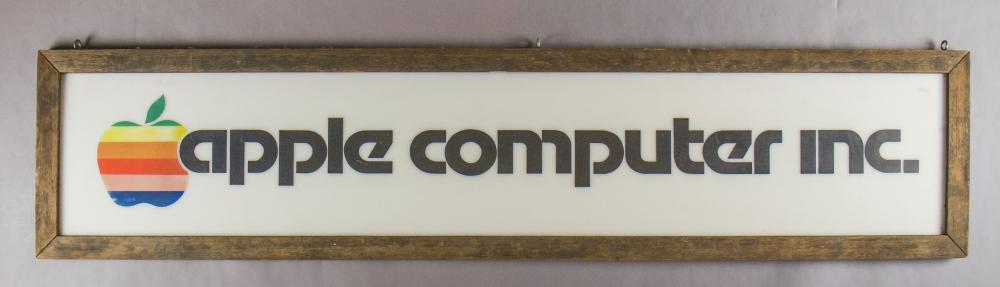
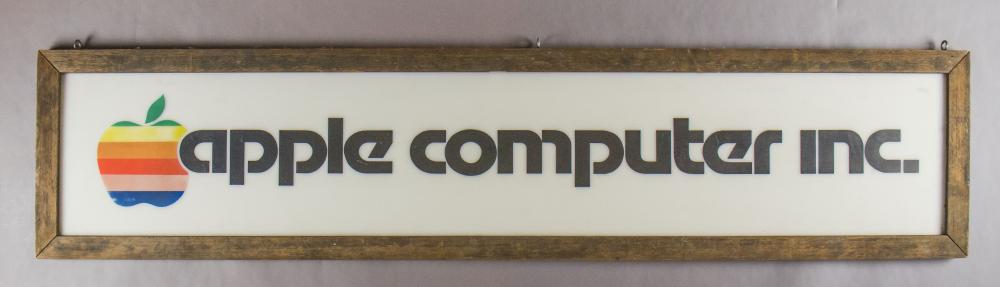
Alexander Historical Auctions is auctioning off a couple of early Apple collectibles including Apple Computer’s first trade sign.

Source: Alexander Historical Auctions

The sign is estimated at $100,000 to $200,000, with a start price of $50,000.

This was the very first sign used by Steve Jobs and Steve Wozniak to promote their Apple Computer start-up, and was displayed at the first trade shows Apple attended in 1976.

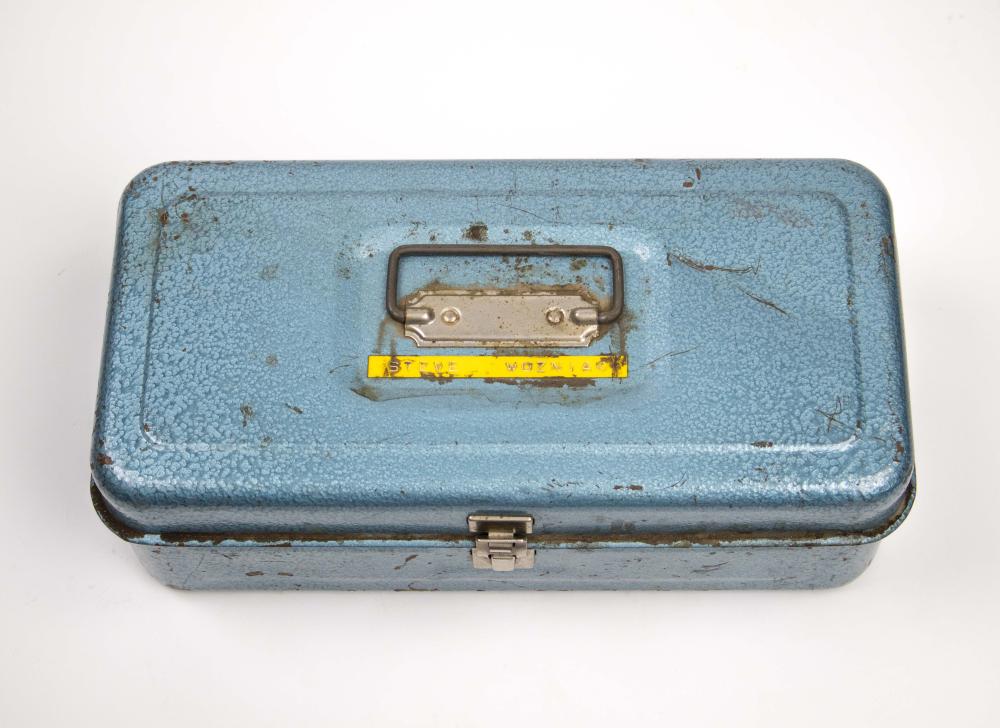
If this item is too rich for your blood, you might want to consider picking up Steve Wozniak’s first Apple Computer tool box.

Source: Alexander Historical Auctions

It even has the original LabelMaker label with Wozniak’s name on it.

The starting bid is $10,000, with an estimate of $20,000 to $30,000.

This is your chance to get unique, rare, one-of-a-kind Apple collectables.

Please note: This auction includes other items that some may find disturbing.

Disclosure: Author owns AAPL.

Gisele Bündchen Stock Index Still Beats the S&P 500

Renan Katayama, CC BY-SA 2.0 https://creativecommons.org/licenses/by-sa/2.0, via Wikimedia Commons

by Fred Fuld III

Some of you may know Gisele Bundchen as the famous Brazilian supermodel. Some of you may know Gisele as the wife of American football player Tom Brady. Some of you may know her as both.

Unfortunately, the recent news about her relates to marital issues with Brady.

However, What Gisele should be known for is her intelligence, her beauty, and her business acumen. As a matter of fact, back in 2007 when the U.S. dollar was weak, she refused US dollars for some of her contracts and requested Euros instead.

She was the world’s richest supermodel as early as 2007, and has held that title until 2015, according to Forbes.

Back in 2007, I created the Gisele Bündchen Stock Index, which tracked the stocks that Gisele was connected to, primarily as a spokesperson or actress. The article can still be found in our Stockerblog predecessor website.

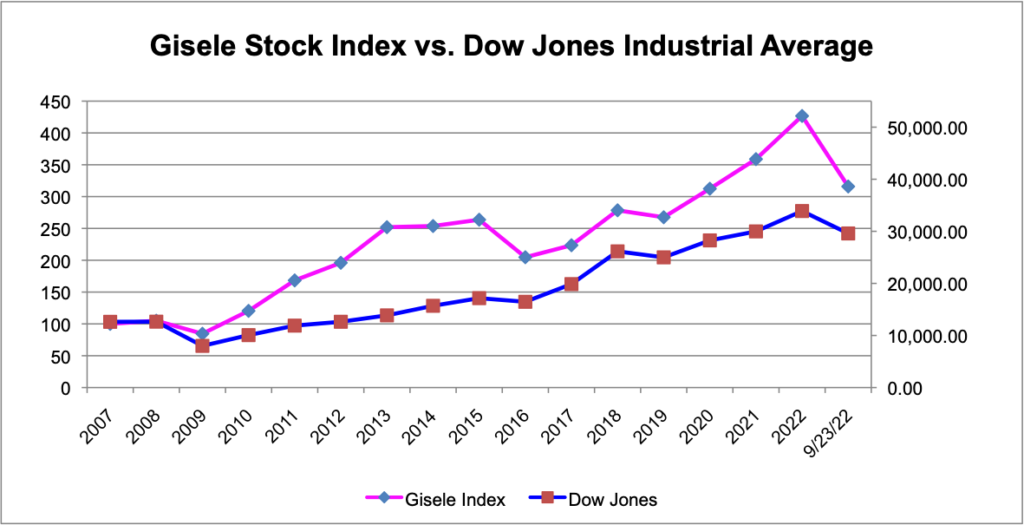
I tracked her stock index against the Dow Jones Industrial Average since then, and over the years, the Gisele stock index has continued to outperform, which you can see in the chart below. Her index even held up better than the Dow during the 2008 stock market crash.

Data Source: Yahoo! Finance: Historical Prices

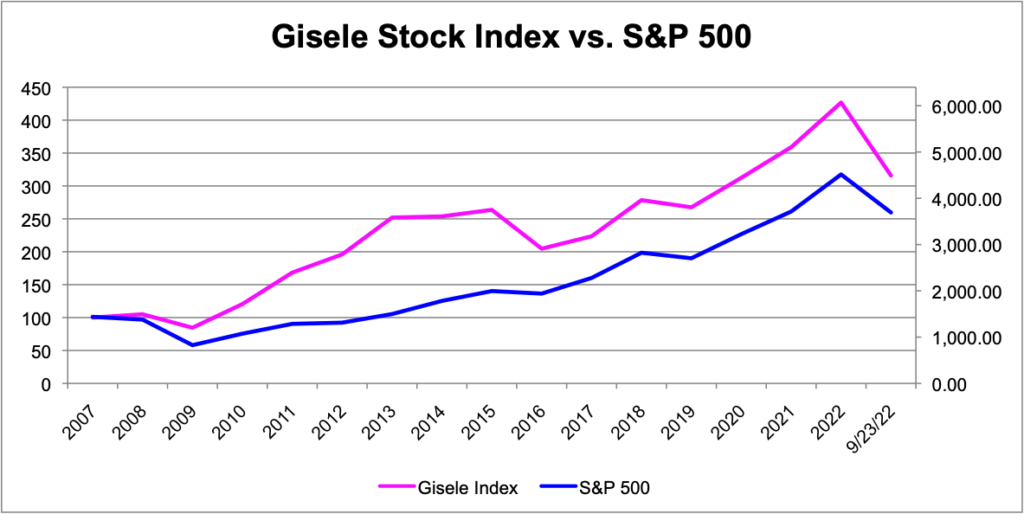
Most stock market investors and stock traders today prefer to look at the S&P 500 as opposed to the Dow, as it more reflects the stock market as a whole.

So here is the Gisele index versus the S&P 500.

Data Source: Yahoo! Finance: Historical Prices

The following companies were included in the current index with information regarding Gisele’s connection. Over the years, a couple stocks were dropped due to lack of trading data for non-US companies, and added due to additional celeb endorsements.

LVMH Moët Hennessy Louis Vuitton S.A. (LVMUY) owns several companies that Gisele was the spokesperson for, including Louis Vuitton (a luxury French fashion company), Givenchy ( French retailer of clothing, accessories, perfumes and cosmetics), Guerlain (the oldest perfume house in the world), and Céline (a French ready-to-wear and leather luxury goods brand). Since 2007, the stock has increased by 733%.

She was also the advertising campaign face for Ralph Lauren Corp. (RL). That stock has gone up 27% since 2007.

Gisele was the celebrity endorser for Vivo Participacoes S.A. (VIV), the largest mobile phone service provider in Brazil and in South America. The stock has actually dropped 9% since 2007.

She starred in the comedy, Taxi, in her movie debut, and The Devil Wears Prada , both produced by 20th Century Fox, formerly a division of News Corp. (NWS) at the time the Gisele Index was created. The stock, which was actually involved in a spinoff and skews the return, is down 31% since that time.

For Disney (DIS) she was a celebrity endorser and appeared in the ‘Year of a Million Dreams’ celebration photoshoot. Disney has moved up 241% since 2007.

Gisele was a spokesperson for Procter & Gamble (PG), increased Pantene’s sales in Brazil by 40% during her celebrity endorsement. The stock has had a solid return of 230%.

Finally, she was the spokesperson for the Volkswagon (VLKAY) TV commercials. The stock has had a superior return of 748% since 2007.

Based on the above stocks in the portfolio, the Gisele Index has increased by 215.89%, versus 134.44% for the Dow and 156.79% for the S&P 500.

There is one other stock that Gisele was involved with. She appeared on the Apple (AAPL) ‘Get a Mac’ advertisements to promote the new line of Macintosh’s.

Over the years, I have left Apple out of the index because the return on it was so gargantuan, I thought it would really skew the returns and the charts.

Do you know how much Apple has increased since 2007? The stock has gone up by 5,663%!!!

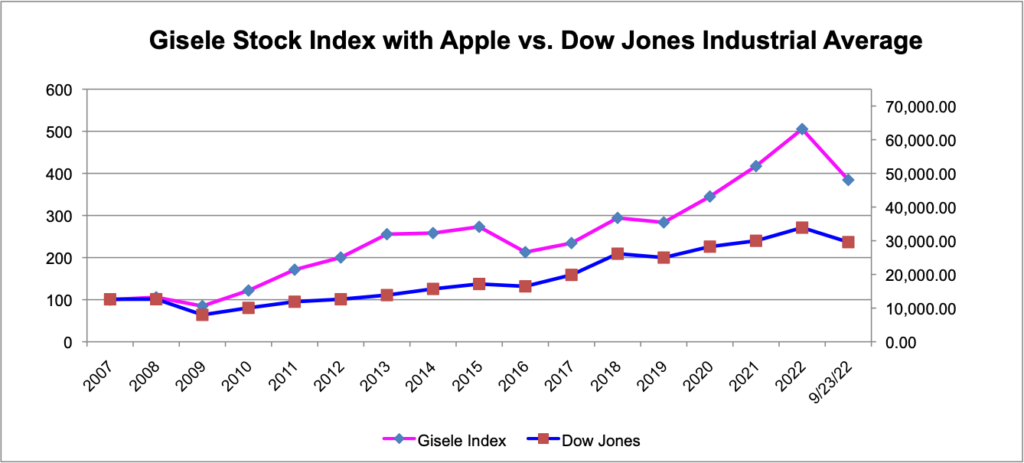
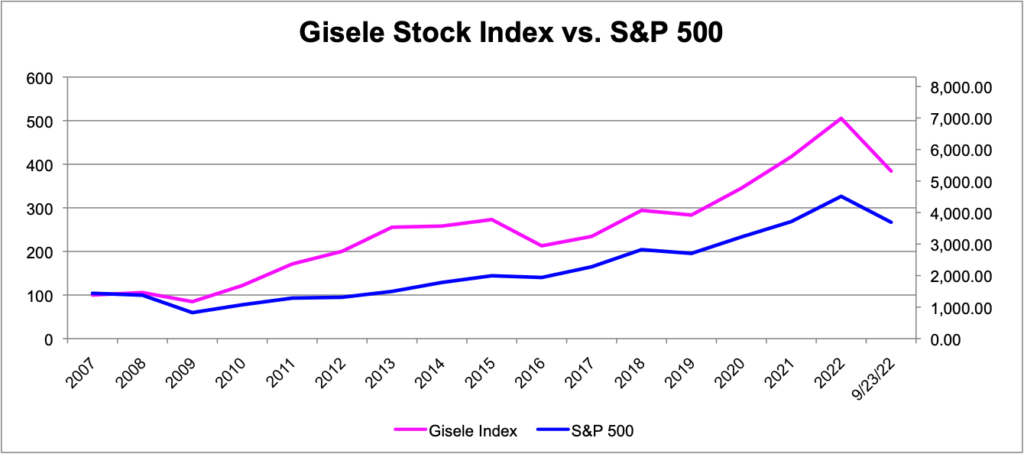
Here are the charts for the Gisele Index which INCLUDES Apple.

Data Source: Yahoo! Finance: Historical Prices

Data Source: Yahoo! Finance: Historical Prices

By including Apple in the index, the return is boosted to 284%, compared to the 216% without it.

Maybe some of these stocks might look attractive to you at the right price. At some point they should become fashionable, and may continue to outperform.

Prices are beginning of year first trading day close, adjusted for splits, dividends, and capital gains distributions. The Gisele Index is a price-weighted index, similar to the Dow Jones Industrial Average.

Disclosure: Author owns AAPL and DIS.

MAGA is the New FAANG

Do you remember what the FAANG stocks are, or were? MAGA is the New FAANG.

by Fred Fuld III

Do you remember what the FAANG stocks are, or were?

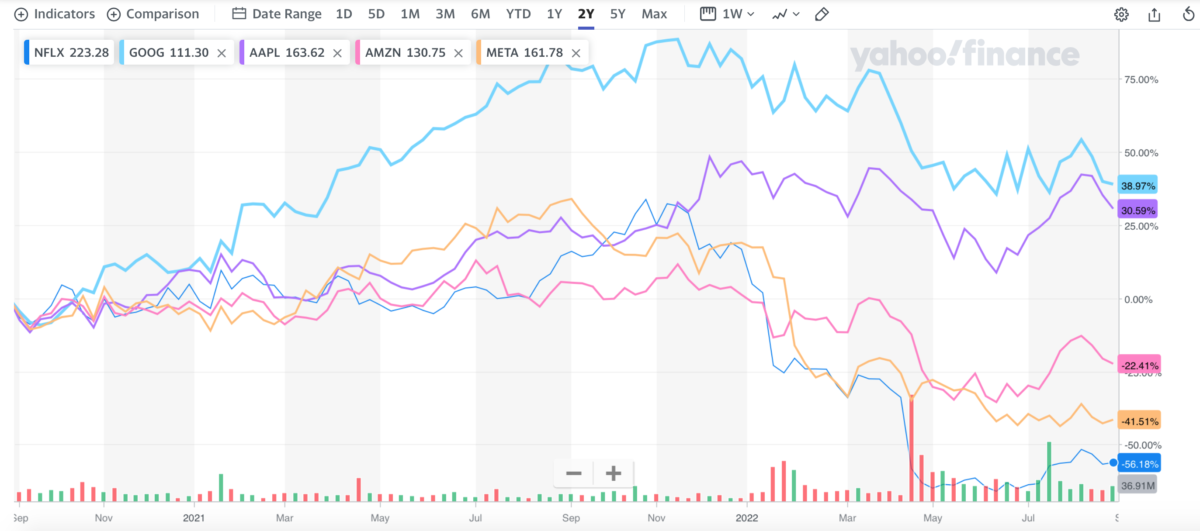
Facebook (FB) (META), Amazon (AMZN), Apple (AAPL), Netflix (NFLX), and Google (GOOG) (GOOGL).

Jim Cramer created the FANG acronym back in 2013 for Facebook, Amazon, Netflix, and Google, because he said that these tech stocks were “totally dominant in their markets“.

However, in 2017, he added Apple due to its growth, adding an extra A to the acronym, changing it to FAANG.

Yet, several changes have taken place since then. First, Facebook has changed its name to Meta,along with its symbol, so the letter M has to be used in the acronym.

Second, Netflix is not really a tech stock. It is actually considered an entertainment company in the communications services sector. Plus, many investors no longer consider it a growth stock if you look at the return over the last few years.

Just in the last twelve months, Netflix has dropped over 61%. If you had bought the stock at the beginning of 2018 and held it, you would have barely broken even. If you had bought in in 2019, 2020, or 2021, and held it, you would have a good size loss.

Finally, even though Google changed its name to Alphabet, nobody calls it that, and the company is still keeping the same stock ticker symbols beginning with the letter G.

So that gives us Meta, Amazon, Google, and Apple as the leading tech stocks.

Or to abbreviate it, MAGA.

Now that should be easy to remember.

Disclosure: Author owns MSFT, AAPL and AMZN.

MORE POPULAR STOCK LISTS OF INTEREST

Top 10 Short Squeeze Plays

Stocks Going Ex Dividend

Business Development Companies Paying Over 10%

How to Invest in Apple Without Buying Apple Stock Plus Get Free Diversification

by Fred Fuld III

Apple (AAPL) has dropped about 18.7% from its high over the last several months. If you think the stock has bottomed out, and may be on the rise, there is an alternative to just buying the stock outright.

No, I’m not talking about stock options. What I’m referring to is Warren Buffett’s Berkshire Hathaway (BRK-A) (BRK-B). Do you realize that Apple makes up 47.6% of the Berkshire Hathaway portfolio?

So if you buy Berkshire, that means that almost half your funds are indirectly invested in Apple.

So what else do you get when you buy Berkshire, besides Warren Buffett’s expertise?

Here are some of the other stocks that make up a large portion of the portfolio:

Bank of America (BAC) 13.5%

American Express (AXP) 7.5%

Coca-Cola (KO) 7.2%

Kraft Heinz (KHC) 3.5%

Moodys (MCO) 2.9%

There are actually over 40 stocks in the Berkshire Hathaway portfolio, spread out over a lot of different industries, so it is well diversified.

I’m not recommending Berkshire as an investment because I think the bear market will continue (and I never make any stock recommendations anyway), but if you are bullish on Apple and you don’t mind a little stock market diversification, you might want to take a look at Berkshire, if not now then at some point when you believe the market has bottomed out.


Disclosure: Author owns AAPL and KO.