Looking at Smart Glasses Stocks: Are These Intelligent Spectacles a Reality?

by Fred Fuld III

Here is a tight, practical breakdown of Google Glass, Snapchat Spectacles, Apple Vision Pro, and Meta’s Ray-Ban smart glasses: what each does well, where each struggles, and a short list of genuinely useful features none of them reliably offer today.

Quick summary

  • Google Glass (Enterprise Edition 2) — ultra-light, workplace tool for heads-up info and hands-free workflows; limited consumer features and modest display power.
  • Snapchat Spectacles (recent AR models) — focused on AR visuals and social/creative experiences; promising optics but immature battery/software and developer-targeted releases.
  • Apple Vision Pro — highest-end mixed-reality platform: great displays, sensors, and interaction model; very expensive, heavy, and not pocketable.
  • Meta Ray-Ban (Stories / Meta Ray-Ban Smart Glasses) — stylish, socially oriented capture + audio (calls), reasonably discreet; limited AR, short capture use cases, privacy concerns.

Detailed pros & cons

Google Glass (Enterprise Edition 2)

Advantages

  • Extremely lightweight and unobtrusive, suitable for long wear in industrial or medical workflows.
  • Built around enterprise integrations (Android management, video for remote assist, purpose-built apps).

Disadvantages

  • Not intended as a consumer AR/entertainment device — small display resolution and limited FOV compared to modern AR headsets.
  • App ecosystem and polish are oriented to niche enterprise cases, so general consumer value is low.

Best use case: warehouse, manufacturing, remote assistance, hands-free checklists.


Snapchat Spectacles (latest AR Spectacles)

Advantages

  • Designed specifically for rich AR overlays (hand-tracked interactions, virtual objects in space) and social/creative features — strong ambitions for AR experiences.
  • Snap focuses on developer tools and content creation workflows that link to Snapchat’s social platform.

Disadvantages

  • Early developer/preview product status — short battery life, narrow FOV complaints, and immature software reported by press and ex-employees.
  • Monthly developer fees / limited availability in early rollouts make them less useful for casual buyers.

Best use case: AR developers, creators experimenting with spatial filters and social AR content.


Apple Vision Pro

Advantages

  • State-of-the-art mixed reality: very high-resolution micro-OLED displays, many cameras/sensors, excellent eye- and hand-driven UI, strong app and media ecosystem potential.
  • Powerful silicon (M2 + R1 variants), strong spatial audio, and platform features (OpticID, immersive video) for productivity and entertainment.

Disadvantages

  • Very expensive and relatively heavy — not something you wear out in public all day; comfort over long sessions can be an issue for some users.
  • Because it’s individualized (eye calibration/OpticID), casual “share the view” experiences are awkward. Battery life / portability tradeoffs vs. glasses form-factor remain.

Best use case: immersive productivity, cinema/3D media, pros experimenting with spatial apps — when cost/portability are less important.


Meta Ray-Ban (Ray-Ban Stories / later Smart Glasses)

Advantages

  • Fashionable, familiar sunglasses/eyewear look — socially acceptable form factor for short capture and hands-free audio/calling.
  • Easy POV photo/video capture and decent microphone/phone integration for calls; improvements (newer models) raise camera and audio specs.

Disadvantages

  • Not a true AR display (mostly capture + audio) — minimal spatial overlays or immersive apps.
  • Use cases often feel novelty-focused (short social clips) rather than utility-driven; raises privacy concerns when people around you don’t know they’re being recorded.

Best use case: casual POV capture, hands-free calls, social sharing where style matters.


Features users want that none of these deliver well (or at all)

Below are practical, high-value features that are either missing or poorly implemented across current smart glasses:

  1. All-day battery in a real glasses form factor
    • Current AR and camera glasses compromise between battery, weight, and heat. A lightweight pair that reliably lasts a full waking day with mixed use (notifications, low-power AR, occasional video/photo) would be a major win.
  2. High FOV, high-brightness transparent AR with low power
    • Narrow “mail-slot” FOVs limit compelling AR. A wider, true see-through holographic display that stays viewable outdoors without huge power draw is missing.
  3. Robust privacy & social signaling built in
    • A hardware indicator that clearly communicates recording/AR use, plus standard privacy modes (auto-blur faces, soft-recording) would reduce social friction.
  4. Interoperable spatial AR standards & cross-device sharing
    • Seamless handoff/visibility of AR objects between different vendors’ glasses (and phones) — e.g., a shared persistent AR note anchors that anyone with supported glasses can see.
  5. Passive contextual sensing (low-power) for useful ambient assistance
    • Glasses that quietly recognize objects/labels/menus and show unobtrusive contextual help (translations, recipes, safety warnings) without needing a full AR app session.
  6. Modular optical inserts & prescription support that preserve AR alignment
    • Practical AR for eyeglass wearers is still awkward; prescription inserts that keep display calibration accurate would broaden the audience.
  7. True social/comfort design: instant “look up” interactions
    • Lightweight designs that let people glance at minimal info (notifications, direction prompts) without breaking social norms — current devices either overdo or underdeliver.
  8. On-device generative AI assistants with privacy controls
    • Localized, low-latency language & vision models that can summarize what you see, translate in real time, or generate contextually relevant suggestions — but run with privacy safeguards and user control.

Short recommendation by user goal

  • If you want enterprise hands-free tools: Google Glass (Enterprise) is the pragmatic, proven pick.
  • If you want social AR creation / developer experimentation: Snap’s Spectacles (current AR lineup) — but expect rough edges.
  • If you want the best immersive MR experience (and money is no object): Apple Vision Pro.
  • If you want everyday-looking glasses for quick capture + calls: Meta Ray-Ban smart glasses

Looking at the financials of the four companies that make these glasses, Google, actually Alphabet (GOOGL) has a trailing price to earnings ratio of 27.5 and a forward P/E of 25, with a price to earnings growth ratio of 1.85. The dividend yield os 0.2%.

As for Snap (SNAP), the company has been generating negative earnings and does not pay a dividend.

Apple (AAPL) trades at 36 times trailing earnings and 30 times forward earnings. The PEG ratio is 3.59, and the yield is 0.4%.

Meta (META) has a trailing P/E of 27.5, a forward P/E of 21, and a PEG of 2.28. The yield is 0.3%.

There is one much smaller company involved in the production of smart glasses, Vuzix (VUZI). The market cap is only $229 million.

Obviously, the smart glasses business makes up only a very small portion of the revenues of the four major companies involved in this industry. However, if and/or when smart glasses ever takes off, it could add a significant amount to the companies’ bottom line.

Disclosure: Author owns Apple. No recommendations are expressed or implied.

Recent Stock Market Industry Trends: Not Just AI

by Fred Fuld III

Recent weeks have been characterized by intense market activity, but this activity is not uniform. The most prominent and influential sectors have been Information Technology and Communication Services, where performance is being driven by the relentless advancement of generative AI and strong growth in the digital engagement economy. These sectors, which represent a significant portion of the S&P 500, have been the primary engines of the market’s recent rally.

However, the term “active” also encompasses periods of extreme volatility and weakness. This is most acutely demonstrated in the Healthcare sector, which has been highly active due to a dramatic bifurcation in performance. A major sell-off in the health insurance sub-industry, triggered by fundamental business challenges and disappointing earnings, stands in stark contrast to robust growth and investor confidence in pharmaceuticals and biopharma. The broader market is navigating a complex macroeconomic landscape. While optimism over strong corporate earnings and the potential for a Federal Reserve rate cut provides a powerful tailwind, this is tempered by persistent risks from rising bond yields and escalating geopolitical tensions over tariffs. This dynamic creates a push-pull effect, demanding a highly selective and data-driven investment approach from market participants.

The Macroeconomic Backdrop: A Push-Pull Market Environment

To properly understand the recent trends in specific industries, it is essential to first analyze the broader macroeconomic context. The market has been operating in a complex environment defined by a combination of positive catalysts and persistent risks.

The overall sentiment has been cautiously optimistic, leading to positive performance in the major US stock indexes. The S&P 500 recently rose 0.8% in a single day, leaving it just shy of a new record set the previous week. The Nasdaq composite, which is heavily weighted toward technology and growth companies, added 1% to reach a new record high.Over a trailing one-month period, the S&P 500 has climbed 2.01% and is up 19.56% year-over-year. The Nasdaq has also shown significant strength, rising 3.9% over the past week and 11.1% over the last four weeks. The fact that the Nasdaq Composite is reaching new records while the S&P 500 and Dow Jones Industrial Average are showing more modest gains suggests that the current market rally is not a broad-based, all-boats-rising tide. Instead, it indicates that capital is disproportionately flowing into the technology and communication services sectors, which are the primary constituents of the Nasdaq. This targeted rally supports the central thesis that these specific sectors are highly active and influential.

The market is also contending with a series of significant economic drivers and risks. A major source of optimism stems from the prospect of potential interest rate cuts by the Federal Reserve later in 2025. This sentiment was strengthened following a weaker-than-expected US jobs report, which firmed up expectations for a rate cut at the Fed’s policy meeting in September. The possibility of lower interest rates is generally seen as a positive for equities, as it can reduce borrowing costs and stimulate economic activity. However, this positive force is being counteracted by persistent risks from rising bond yields. A rise in the “term premium”—the additional compensation lenders demand for longer-term loans—has been putting upward pressure on bond yields, which in turn pressures stock price-earnings (P/E) ratios and stock prices. This dynamic is a core reason why some analysts believe the market could be confined to a “trading range” for the remainder of 2025, as this push-pull effect creates natural upper and lower boundaries.

Another significant geopolitical headwind is the return of “hawkish tariff talk”. Investors are concerned that new tariff measures could harm corporate margins and disrupt global trade. This is not a theoretical risk; the decision by the US to raise tariffs on Indian exports to 50% caused a significant sell-off in export-oriented sectors and led to Foreign Institutional Investors (FIIs) pulling billions of dollars out of Indian equities. The market is also operating with major indices near record levels, which places a high burden on companies to deliver exceptional performance to justify their current valuations. With the market not priced for an adverse outcome, any negative news or macroeconomic surprises could trigger significant volatility. This environment underscores the need for selective investing, as only companies with strong fundamentals and innovative growth drivers can sustain investor confidence.

To provide a foundational, data-rich overview of the market’s structure, the following table details the weighting and recent performance of the sectors within the S&P 500.

SectorWeighting in S&P 500 (%)Trailing six-month performance (%)Trailing 12-month performance (%)
Information Technology31.6-0.414.6
Financials14.30.126.1
Consumer Discretionary10.6-3.721.7
Communication Services9.67.320.9
Health Care9.6-9.1-4.7
Industrials8.70.218.9
Consumer Staples5.93.115.8
Energy3.0-13.0-7.3
Real Estate2.1-5.515.9
Utilities2.50.418.2
S&P 500 Index-1.314.4
Data from Schwab, as of July 18, 2025 

The Engines of Growth: Technology and Communication Services

The most active and influential sectors in the market over the last few weeks have been Information Technology and Communication Services. Their outperformance has been driven by a confluence of powerful trends, most notably the generative AI revolution and the continued expansion of the digital engagement economy.

Information Technology: The Generative AI Revolution

The Information Technology sector, with an enormous 34.0% weighting in the S&P 500, has been the single largest driver of overall market performance. The central catalyst for this activity is the ongoing and accelerating generative AI boom. This is not merely a passing trend but a transformative force that is already leading to billions of dollars in productivity gains as companies leverage AI assistants to help human developers write and test code. The demand for computing power to support these workloads is exponentially increasing, capturing the attention of both management teams and the public.

The recent Q2 2025 earnings reports from major tech companies provide concrete evidence of how this trend is translating into tangible financial results. Shares of Meta Platforms (META) jumped 11% to an all-time high following a strong report, with CEO Mark Zuckerberg crediting AI for unlocking greater efficiency and gains in their ad system. Amazon’s (AMZN) revenue grew 13% year-over-year, and its cloud services division (AWS) revenue increased 18%, both exceeding analyst projections. Microsoft (MSFT) also paced sector gains after releasing its earnings report. Even companies like Apple (AAPL), which are seen as less directly involved in AI infrastructure, are benefiting; its iPhone sales climbed 13%, and its total number of active devices reached an all-time high, indicating strong consumer engagement with the digital ecosystem.

The AI story extends far beyond the final software or platform product. It has created a complex value chain that is driving activity in hardware and infrastructure. The semiconductor industry, which is the foundational layer for AI, is projected for double-digit revenue growth in 2025, primarily driven by the surging demand for gen AI chips such as CPUs, GPUs, and data center communications chips. This trend is benefiting a wide range of companies, from market giants to specialized players.

For example, Advanced Micro Devices (AMD) ranked among the best-performing stocks in July 2025, and some analysts see Micron Technology as an undervalued stock to watch, noting that it is the “preferred memory provider” for Nvidia’s latest AI accelerators. The fact that investors are actively pursuing companies in the hardware and memory space demonstrates a thorough understanding of the AI value chain. The demand for compute-intensive workloads is creating new challenges for global infrastructure, from data center power constraints to supply chain delays, which implies that the investment theme will continue to expand into a broader range of infrastructure-related companies.

Communication Services: The Resurgence of Digital Engagement

The Communication Services sector, with a substantial 9.6% weighting in the S&P 500, has also been a highly active area for investors, exhibiting a robust 20.9% performance over the trailing 12 months. This sector relies heavily on advertising and subscription-based revenue, which tends to rise when the economy is expanding. The recent stock activity and corporate results provide a clear picture of this trend in action.

A compelling case study is the performance of Roblox (RBLX), an online gaming and game creation platform. Its stock was one of the best performers in July 2025, with shares soaring by 19.66% in pre-market trading after a strong Q2 earnings report. The exceptional results were driven by significant growth in key metrics: revenue was up 21% year-over-year, bookings increased by an impressive 51%, and Daily Active Users (DAUs) grew by 41% to over 111 million. This growth was fueled by new, viral content, such as the game “Grow a Garden,” which was launched in March 2025 and set a world record for concurrent users in Q2. The fact that DAUs aged 13 and over now account for 64% of total users and 66% of all hours played suggests a maturing user base with significant spending power, signaling strength in the broader digital economy.

The sector’s activity is not limited to gaming. Comcast, a telecommunications and entertainment giant, also saw its stock rise more than 2% after beating earnings estimates. The company’s Q2 results were mixed but showcased strategic strengths; while it lost video and residential voice customers, it saw revenue growth in its domestic broadband and wireless divisions. The company also benefited from the successful opening of its Epic Universe theme park, which led to a 6% growth in its Content and Experiences segment. However, not all companies in the sector fared as well, with Charter Communications being listed as one of the worst-performing stocks of July 2025. This divergence highlights that even within a highly active sector, a selective approach is crucial.

The Paradox of Activity: Healthcare’s Bifurcated Market

The Healthcare sector provides a critical, nuanced perspective on market “activity.” While the sector has a significant weighting in the S&P 500, its recent performance is a study in contradiction. Instead of moving in a single direction, capital flows have been dramatically bifurcated, with investors punishing one sub-industry while rewarding others based on their business models and innovation.

The most dramatic recent market activity in Healthcare has been a major sell-off in the health insurance sub-industry. A cluster of major companies, including Centene and Molina Healthcare, ranked among the worst-performing stocks of July 2025. The reason for the sell-off was not just market sentiment but a series of fundamental business problems. Centene, for example, saw its stock plummet after it pulled its full-year 2025 earnings guidance. The company revealed that enrollment numbers in its health insurance marketplaces were lower than expected and that the enrollees were generally less healthy, leading to a stunning $1.8 billion shortfall in its risk-adjustment program. This is a systemic issue within the managed healthcare industry: the challenge of managing costs in an environment of rising utilization and higher-than-expected patient morbidity. Similarly, Molina Healthcare reported a year-over-year decrease in adjusted net income and a higher Medical Care Ratio (MCR) for its Marketplace business, indicating that the costs of providing care are rising faster than revenue. The fact that this problem is being cited across the sector, with other insurers like UnitedHealth Group also suspending their guidance, demonstrates that this is not an isolated event but a deep-seated challenge facing the business model itself.

In stark contrast, other parts of the Healthcare sector are thriving. A list of “best healthcare stocks to buy” is dominated by companies in drug manufacturers, medical devices, and diagnostics & research.  These companies are being rewarded for having strong “economic moats,” which are competitive advantages that protect their long-term profitability. For example, Novo Nordisk (NVO) is highlighted for its dominance in the diabetes and obesity treatment markets, with its innovative GLP-1 therapies providing a strong barrier against competition. Merck is also noted for its strong drug pipeline and high-margin product lineup. This flight to quality and innovation is further evidenced by a list of high-growth technology companies that includes several biopharmaceutical firms, suggesting that investor enthusiasm for technology extends to its application in drug discovery and development. This bifurcated flow of capital is confirmed by the prominence of Pharmaceutical ETFs, which have significant weightings in companies like Eli Lilly, AbbVie, and Johnson & Johnson. The stark difference in performance suggests that investors are actively punishing companies with strained business models while rewarding those with strong, innovation-driven competitive advantages.

The following tables visually represent the divergence in performance within the Healthcare sector and across other industries.

Top Performers (July 2025)SectorUnderperformers (July 2025)Sector
Comfort Systems USA (FIX)IndustrialsCentene (CNC)Healthcare
Roblox (RBLX)Communication ServicesMolina Healthcare (MOH)Healthcare
GE Vernova (GEV)IndustrialsCharter Communications (CHTR)Communication Services
PTC (PTC)TechnologyAlign Technology (ALGN)Healthcare
Advanced Micro Devices (AMD)TechnologyLiberty Broadband (LBRDA)Communication Services
Data from Morningstar, as of August 1, 2025

Conclusion: Implications for Investors and Forward Outlook

The most active industries for stock investors in the last few weeks have been Information Technology and Communication Services, driven by a powerful and concentrated rally around generative AI and digital engagement platforms. These sectors are providing the primary momentum for the broader market, with strong corporate earnings justifying high valuations and fueling investor optimism. However, the term “active” is also defined by a significant and telling divergence, most evident in the Healthcare sector, where investors are fleeing from managed care companies facing systemic cost issues and re-allocating capital toward innovative, moat-protected biopharma and medical device companies.

For investors, this bifurcated market presents a critical lesson: selectivity is paramount. A broad, passive approach to a sector like Healthcare would have been disastrous in July, while a highly selective approach could have yielded significant returns. The outsized influence of a few mega-cap technology stocks presents a concentrated opportunity, but also a risk if those companies fail to deliver. This is reinforced by the broader macroeconomic picture, which suggests a potentially “rangebound” market for the remainder of 2025. This environment highlights the value of diversification, not only across sectors but also into other asset classes like international stocks and precious metals.

The forward trajectory of these active industries will likely be determined by three key factors. First, the pace of AI innovation and adoption will continue to be a primary driver. The market will be watching to see if demand for AI hardware and software can continue to drive earnings, or if scaling challenges and new competitors will temper growth.Second, the market’s direction will be dictated by the delicate balance between corporate earnings and macro policy. Companies must continue to deliver strong results to justify their high valuations, especially in the face of rising bond yields and geopolitical tariff risks. Finally, the Healthcare sector’s path forward depends on how the health insurance sub-industry responds to its fundamental cost challenges, and whether the pharmaceutical sub-industry can continue its innovation-driven growth, which has proven to be a shield against broader market pressures.

Disclosure: Author owns several of the above mentioned stocks including AAPL, AMZN, and MSFT.

Now the Counterfeiters are Making Fake Junk Coins

by Fred Fuld III

When I started looking into silver as an investment a few years ago, not only did I look at silver mining stocks and iShares Silver Trust ETF (SLV), I also started buying silver coins.

I was aware of the counterfeit coins that were floating around, primarily the silver rounds and the uncirculated silver dollars. Because of that, I considered buying slabbed coins (the ones that are graded and encapsulated in plastic), but they are pretty expensive and sell for much more than the silver content, so I went for the low quality silver coins, figuring no one would bother counterfeiting those.

I was wrong.

You can buy coins on such sites as eBay (EBAY), Etsy (ETSY), Amazon (AMZN), Facebook (META), Whatnot, Craigslist, and many other eCommerce sites. Certain sellers on some of these major selling sites are offering cull coins below silver melt prices. These aren’t auction start prices, these are actual “for sale” prices.

Let me explain what a cull coin is. A “cull coin” refers to any coin that is considered to be in poor condition or has flaws, making it undesirable for collectors, but potentially attractive for investors seeking, in this case, silver content. The cull coin may have a hole, may be cleaned (remember, never clean an old coin – it will reduce the value substantially), may be bent, or may be heavily scratched.

But let’s get back to prices. Why would someone sell a coin for five or ten dollars less than competitors? Why would they sell for less than the value of the silver content? Why? Because they are fake.

What I can’t understand is why are the counterfeiters making fakes of cheap coins? I can understand making fake uncirculated coins because of the higher value, but low quality junk? It’s hard to believe, but I guess if there is a market for something, someone will create a fake.

In order to avoid getting stuck with any of these fakes, here’s what you need to check:

• Is the coin selling for far less than similar coins?

• Does the seller have very little feedback?

• Does the seller have significant negative feedback?

• Did the seller recently create an account?

• Does the seller copy pictures from other sellers?

If any of the above are true, be careful.

The best thing to do is to buy from sellers who have been selling for years and have excellent feedback.

Silver Coins and Authenticity

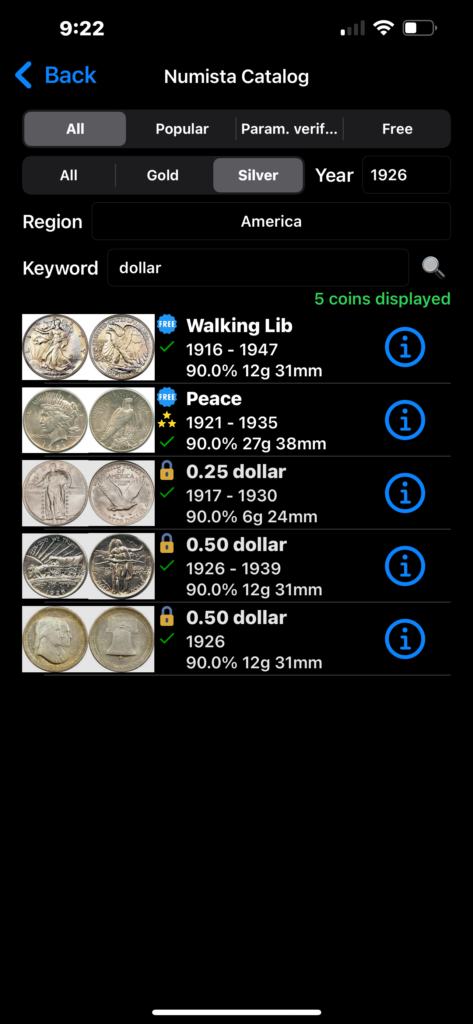
All three of the above items are FAKE!


Be careful about buying silver coins, as there are many fakes being distributed. These are not just the coins with numismatic value but also the so-called junk silver coins and even the bullion coins (silver rounds). 

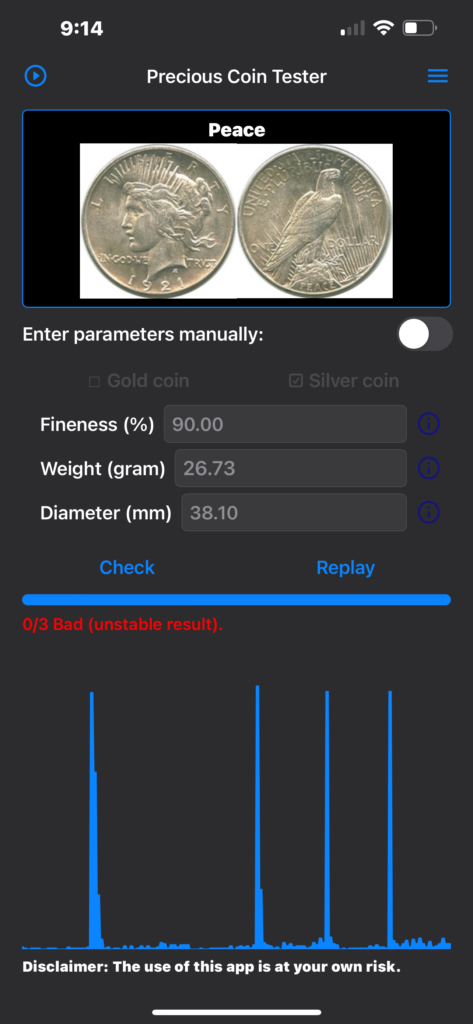
Fortunately, there are several ways of checking whether a coin is genuine or not. One simple way is to use a phone app called CoinTester. It measures the sound of the ping when the coin is hit with an object, like a pencil.

First, you choose the type of coin. (Note: If you are checking a silver dollar, for Keyword, just type Dollar, not Silver Dollar.) You place the coin on your fingertip, tap the word Check on the app, then hit the coin a few times with something that won’t damage the coin (I use the wooden part of a pencil.) If is shows a 0 or 1 out of 3, it means the coin is a fake. If it shows a 2 or a 3 out of three, the coin is real.

Just remember that all tests for coins aren’t foolproof. The best approach is to buy from a very reputable coin dealer.

Many numismatic coins are slabbed. In numismatics (the study or collection of coins), “slabbed” refers to the process of encapsulating a coin in a hard plastic holder, often called a slab. These slabs are usually sealed and graded by a professional coin grading service. The purpose of slabbing coins is to protect them from damage and to provide an objective assessment of their condition and authenticity.

When a coin is slabbed, it is typically accompanied by a label indicating its grade, which is determined based on factors such as wear, luster, strike quality, and any imperfections. This grading process helps collectors and investors assess the value of the coin and provides assurance about its authenticity and condition.

Slabbed coins are often considered more desirable for collectors and investors because they come with a trusted third-party evaluation, reducing the risk of buying counterfeit or over-graded coins.

So if you decide to add silver coins to your investment portfolio, buy with caution.

Disclosure: Author owns EBAY, AMZN, and has a long option position in SLV.

Stocks Owned by the Top 5 Billionaires

Forbes’ 2024 list of the world’s richest people highlights top figures from different fields. Leading the list is Bernard Arnault & family, who hold the title of the wealthiest individual globally with a net worth of $213.5 billion. Jeff Bezos and Elon Musk follow closely behind, with fortunes of $197 billion and $191 billion, respectively. Mark Zuckerberg and Larry Ellison complete the top five, boasting significant wealth from their own ventures. Below are the stocks associated with each of them.

  1. Bernard Arnault & Family- $213.5 Billion 

Louis Vuitton, part of LVMH, also known as Moët Hennessy Louis Vuitton (LVMUY), is a famous luxury brand known for its high status, top-notch quality, and expert craftsmanship. Investors like it for its strong reputation and its position as a top luxury fashion brand worldwide. LVMH also shows steady sales growth in many places and is making more profit, showing it’s strong and could keep doing well. Investors like Louis Vuitton for its creativity by always coming up with new ideas. Buying Louis Vuitton stock means believing in the brand’s lasting popularity, its money stability, and its chances to grow more in the luxury market.

  • Jeff Bezos – $197.6 Billion

Investors find Amazon stock (AMZN) attractive because of its strong presence in online shopping, cloud services, and other industries. Amazon’s constant innovation, wide-reaching customer base, and well-known brand make its stock very appealing for investors. Its stable income from different sources like Amazon Web Services (AWS) and online sales suits are very appealing for both short-term and long-term investors. Positive feelings about Amazon’s financial performance, such as its cash flow and market position, add to the reasons why stock is so popular. Overall, Amazon’s reputation for growth and resilience continues to drive investor interest and support.

  • Elon Musk – $191.1 Billion

Tesla (TSLA) stands out as a top player in the electric vehicle (EV) scene, known for its creative tech and game-changing strides in eco-friendly travel. This draws in investors who see the promise of electric cars and believe in Tesla’s role in shaping the car industry of tomorrow. Plus, Tesla’s CEO, Elon Musk, is quite a character, and his big ideas earn him trust from investors. Musk dreams of making cars drive themselves and expanding Tesla’s energy-saving solutions, which excites his followers looking for big investment chances. Tesla’s got a solid fan base too, making it more than just a car company; it’s a symbol of moving forward and doing things differently.

  • Mark Zuckerberg – $155.7 Billion

Meta (META), previously Facebook, is a top social media platform with over 3 billion users worldwide, making it a great choice for investors looking to tap into the digital advertising market. Meta’s move into virtual reality (VR) and augmented reality (AR) tech, like the Oculus VR headset, shows its commitment to growing its revenue sources and staying ahead in technology. Investors also see potential in Meta’s ability to benefit from the recovering advertising market, thanks to its successful ad campaigns and efforts to keep users engaged. Overall, Meta’s long-term strategy, huge user base, and innovative tech projects make its stock an attractive option for many investors.

  • Larry Ellison – $148.5 Billion

Oracle (ORCL) is a big tech company known for its computer software and services, like databases and cloud computing. Investors like Oracle because it’s well-known for providing reliable tech solutions, which makes it a popular choice for people looking to invest in the tech industry. Oracle also grows by buying other companies, like Cerner Corporation, showing it wants to offer more and stay competitive. Plus, Oracle is doing well in cloud computing and has big clients like Zoom Video Communications, which makes investors feel good about its future growth. In general, investors buy Oracle stock because they trust it to keep coming up with new ideas, follow market trends, and make money for its shareholders in the long run.

CompanyCompany SymbolPrice to BookPEGPEPrice to SalesForward PEYield
LVMH Moët Hennessy – Louis Vuitton, Société EuropéenneLVMUY6.482.6226.084.5923.871.65%
Amazon.com, Inc.AMZN9.262.2461.943.2842.55NA
Tesla, Inc.TSLA8.342.7543.046.262.11NA
Meta Platforms, Inc.META7.521.0325.518.1922.520.45%
Oracle CorporationORCL57.291.330.936.2818.731.37%

Could some of these stocks make you a billionaire?

Stay ahead of the game and subscribe to our newsletter now to unlock the hottest investment opportunities!

Subscribe Here

Disclosure: Author owns AMZN.

You can now SELL YOUR VOTES

by Fred Fuld III

I am surprised that there isn’t a law about this. There is a company that provides a vote exchange where you can buy or sell votes.

It is for shareholders of publicly traded companies. The company is called Shareholder Vote Exchange.

The service allows shareholders to sell the rights to the proxy votes of stocks in order to generate additional income.

Companies and activists are the usual buyers.

For example, if you own 1000 shares of Apple (AAPL), you could sell your voting rights for $187.44 to $9,372.00 per year, depending on various factors.

For 1000 shares of Disney (DIS), it would be $91.07 to $4,553.50.

You don’t need 1000 shares, You could sell your votes for 100 or 10 shares, or even 1 share.

For example, if you own 100 shares of Tesla (TSLA), your votes could be sold for anywhere between $22.37 to $1,118.55.

If you had 100 shares of Meta/Facebook (META), you might get $33.50 to $1,675.20 each year.

Here’s a summary of the Shareholder Vote Exchange:

What they do:

  • SVX enables shareholders to buy, sell, and trade their voting rights for upcoming company meetings on their online platform. This allows passive investors who are not interested in voting to monetize their votes, while also giving activist investors and companies a way to acquire additional voting power.

Key features:

  • Unique auction system: SVX uses a proprietary auction system designed to optimize value for both vote sellers and buyers.
  • Integration with major brokers: The platform is integrated with major brokers like Schwab and Vanguard,making it easy for shareholders to participate.
  • Regulatory compliance: SVX’s auctions comply with all applicable state and federal regulations, ensuring transparency and investor protection.

Benefits for shareholders:

  • Monetize voting rights: Shareholders can earn cash for their votes, even if they are not interested in voting themselves.
  • Increase liquidity: The SVX platform provides a market for votes, which can make it easier for shareholders to buy and sell them.
  • Participate in corporate governance: Shareholders can use the platform to express their views on important company matters, even if they cannot attend shareholder meetings in person.

Current status:

  • SVX is a relatively new company, but it has already attracted a significant amount of interest from investors and the media.
  • The company is currently in the process of expanding its operations and adding new features to its platform.

Potential impact:

  • SVX has the potential to revolutionize the way shareholder voting works. By making it easier for shareholders to buy and sell their votes, the platform could increase shareholder participation in corporate governance and make it more difficult for companies to ignore the interests of their investors.

Now with votes for political candidates, it is illegal to buy or sell a vote, according to 18 U.S. Code § 597 – Expenditures to influence voting.

But that hasn’t stopped people from trying.

Back in the year 2000, some people tried to sell their votes on eBay (EBAY).

Anyway, it will be interesting to see what happens with these shareholder votes.

Disclosure: Author is long AAPL, DIS, and EBAY, and is short TSLA.

Top 5 Pure Play AI Stocks

By Fred Fuld III

You’ve seen it on TV, you’ve read about it on news websites. Artificial Intelligence, commonly referred to as AI, is now the hottest industry. Stocks that are involved in this industry are taking off.

I originally wrote about a form of artificial intelligence back in October of 2021 in an article called The Future of Artificial Intelligence: Can You Invest In It Now?

So you may be wondering what companies are the purest plays.

WHAT AI IS

Artificial Intelligence, or AI for short, refers to the ability of machines to perform tasks that typically require human intelligence, such as learning, reasoning, problem solving, and decision-making. AI algorithms are designed to analyze data, recognize patterns, and make predictions or recommendations based on that analysis.

In other words, AI is a way to teach machines to perform tasks that would normally require human intelligence, and to improve their performance over time based on the data they analyze. This technology has the potential to revolutionize many aspects of our lives, from healthcare to transportation to entertainment. AI is even being used to write articles and books.

WHAT CHAT AI IS

One of the most popular types of AI services is Chat AI. 

Chat AI refers to the use of artificial intelligence technologies, such as natural language processing (NLP) and machine learning, to enable machines to communicate with humans via chat interfaces, such as chatbots or virtual assistants.

Chat AI is used in a variety of settings, such as customer service, where chatbots can be used to answer frequently asked questions, provide information, or help customers troubleshoot issues. Chat AI can also be used in healthcare to provide personalized support and advice, in education to assist with learning, and in business to streamline operations and improve customer engagement.

The key advantage of Chat AI is that it enables organizations to provide 24/7 support to their customers, without the need for human intervention. Additionally, Chat AI can help organizations save costs by automating routine tasks and reducing the need for human labor.

To enable effective Chat AI, developers must ensure that the algorithms are capable of understanding and interpreting natural language, as well as providing appropriate responses to user queries. This requires a combination of NLP and machine learning techniques, as well as ongoing training and improvement of the chat AI system.

Overall, Chat AI is an increasingly popular technology that has the potential to transform the way we interact with machines and automate routine tasks in various industries.

CREATING IMAGES WITH AI

Yes, artificial intelligence is now being used to create images, such as book covers, logos, album covers, and many other purposes. You just need to type in a simple description, and a picture will automatically be created. One of the most popular AI image services is called DALL-E.

DALL-E is an artificial intelligence system developed by OpenAI that is capable of generating images from textual descriptions. The name “DALL-E” is a combination of the artist Salvador Dali and the Pixar character Wall-E.

The DALL-E system uses a combination of machine learning techniques, including natural language processing and computer vision, to interpret textual descriptions and generate corresponding images. It is capable of creating images of objects and scenes that do not exist in the real world, such as a teapot made of giraffe or a snail-shaped harp.

THE BIG PLAYERS

The DALL-E system was trained on a dataset of text-image pairs, which enabled it to learn the relationship between textual descriptions and their corresponding visual representations. The system was trained on a massive amount of data, including images from the internet and text descriptions from a variety of sources.

The potential applications of DALL-E are numerous, including in the fields of art, design, and advertising. It has the potential to streamline the creative process and help artists and designers bring their ideas to life more quickly and easily. However, there are also concerns about the potential misuse of this technology, such as the creation of fake images or the propagation of harmful stereotypes.

First, let’s get the large stocks out of the way. There are many companies involved in AI, ranging from startups to large corporations. However, some of the biggest companies involved in AI are:

Google (GOOG) (GOOGL) is known for its search engine, but it’s also heavily invested in AI, with products like Google Assistant, Google Photos, and Google Translate all utilizing machine learning.

Amazon (AMZN) is using AI in many areas, such as its recommendation engine, its Alexa voice assistant, and its Amazon Go stores, which use computer vision to enable a checkout-free shopping experience.

Microsoft (MSFT) has been investing heavily in AI and has developed several AI-powered products, including Cortana, Skype Translator, and Microsoft Cognitive Services.

IBM (IBM) has a long history of developing AI technologies, and its Watson platform is one of the most well-known examples of AI in action.

Meta/Facebook (META) uses AI in a variety of ways, including facial recognition technology for tagging photos and content moderation.

Apple (AAPL) has been incorporating AI into many of its products, including Siri and Face ID.

NVIDIA (NVDA) is a leading manufacturer of GPUs, which are essential for training and running AI models.

Baidu (BIDU) is a Chinese search engine that is heavily investing in AI, with projects ranging from self-driving cars to voice recognition.

Tesla (TSLA) is using AI in its autonomous driving technology and is working to develop a fully self-driving car.

Alibaba (BABA), the Chinese e-commerce company, is investing in AI to improve its recommendation engine and other areas of its business.

THE PURE PLAYS

Now let’s get to the purer plays in artificial intelligence.

C3.AI

C3.ai, Inc. (AI) is a software company, located in Redwood City, California, that provides enterprise AI solutions for a variety of industries, including energy, healthcare, and finance. The company was founded in 2009 by Dr. Thomas M. Siebel, who is also the CEO of the company.

Before founding C3.ai, Dr. Siebel was the founder and CEO of Siebel Systems, a leading enterprise software company that was acquired by Oracle Corporation in 2006. After the acquisition, Dr. Siebel focused on developing AI-based solutions for the enterprise market and founded C3.ai.

Initially, C3.ai focused on developing predictive maintenance and energy management solutions for the energy industry. The company’s first product, C3 Energy Management, was designed to help utilities optimize their energy generation and distribution systems using machine learning algorithms.

Over time, C3.ai expanded its focus to other industries, including healthcare, financial services, and manufacturing. The company’s current product offerings include C3 AI Suite, which is a platform that enables organizations to develop and deploy AI applications, and C3.ai Ex Machina, which is an AI-powered data science platform for data scientists and developers.

C3.ai has received funding from several prominent investors, including Breyer Capital, TPG Growth, and the Rise Fund. In December 2020, the company went public on the New York Stock Exchange under the ticker symbol “AI,” raising $651 million in its initial public offering.

The stock has a market capitalization of $2.45 billion. This debt-free company has $6.76 in cash per share.

SOUNDHOUND AI

SoundHound AI, Inc. (SOUN) is a Silicon Valley-based technology company that specializes in developing sound recognition and voice-enabled AI solutions. The company was founded in 2005 by Dr. Keyvan Mohajer, who is also the CEO of the company.

Initially, the company started as a music recognition app called “Midomi,” which allowed users to hum or sing a song, and the app would identify the song. Later on, the company expanded its focus to voice-enabled AI technology and changed its name to SoundHound Inc.

In 2015, SoundHound Inc. launched its flagship product, Hound, which is an AI-powered voice assistant. Hound uses a natural language processing (NLP) technology that enables users to speak complex and specific queries in a conversational manner. The Hound voice assistant is available as a mobile app and can be integrated into other devices and applications.

In addition to Hound, SoundHound AI, Inc. also offers a suite of AI-based products and services, including sound recognition technologies for speech-to-text and music identification, and voice-enabled AI solutions for automotive, hospitality, and other industries.

The company has received funding from several prominent investors, including NVIDIA, Samsung, and Tencent Holdings. By 2021, SoundHound AI, Inc. had raised over $250 million in funding.

SoundHound has a market cap of $580 million. The company is debt-free and quarterly sales increased by over 79% year-over-year.

BIGBEAR.AI

BigBear.ai Holdings, Inc. (BBAI) is a technology company that develops and provides artificial intelligence (AI) solutions for defense and intelligence organizations, as well as for commercial customers. The company was founded in 2018 and is headquartered in Reston, Virginia.

BigBear.ai’s technology solutions use AI and machine learning to help customers make sense of large and complex data sets, as well as to automate decision-making processes. The company’s AI-driven solutions are designed to improve situational awareness, increase operational efficiency, and support decision-making across a range of industries and applications.

The company’s solutions cover a range of capabilities, including computer vision, natural language processing, and data analytics. BigBear.ai’s solutions are used in a variety of applications, such as intelligence analysis, threat detection, predictive maintenance, and supply chain optimization.

BigBear.ai has a broad customer base that includes government agencies and commercial customers in various industries. The company has received funding from several venture capital firms, including Riverside Partners, Chart National, and Blu Venture Investors.

In 2021, BigBear.ai announced that it had entered into a definitive agreement to merge with GigCapital4, a special purpose acquisition company (SPAC), in a deal that valued the combined company at $1.57 billion. The merger was completed in August 2021, and the combined company is now publicly traded on the NASDAQ under the ticker symbol “BBAI” as “BigBear.ai”.

This debt-free company has a market cap of $458 million. 

T STAMP

T Stamp Inc. (IDAI) is an identity authentication software company that uses artificial intelligence (AI) to develop solutions for government, enterprise partners, and peer-to-peer markets in the United States, the United Kingdom, and Malta.

T Stamp’s AI-powered solutions leverage biometric science, cryptography, and data mining to deliver identity and trust predictions, protect sensitive user information, and extend the reach of digital services through global accessibility. The company’s solutions include converting biometric and other identifying data into an Irreversibly Transformed Identity Token that serves as a secure tokenized identity. T Stamp also offers solutions for privacy and data protection, document validation, identity verification, geolocation, duplicate detection, and biometric capture.

T Stamp’s solutions serve a variety of industries, including banking/fintech, humanitarian and development services, KYC/AML compliance, government and law enforcement, P2P transactions, social media, and sharing economy, and real estate, travel, and healthcare. The company was incorporated in 2016 and is headquartered in Atlanta, Georgia.

Overall, T Stamp’s mission is to provide secure and scalable identity authentication solutions that leverage AI and advanced technologies to protect user privacy and combat identity fraud.

This is a microcap stock with an extremely low market cap of $18 million, and should therefore be considered extremely speculative. 

MARPAI

Marpai, Inc. (MRAI) is a software company that specializes in developing and deploying artificial intelligence (AI) systems for the enterprise market. The company was founded in 2016 by a team of experienced entrepreneurs and AI researchers, including CEO and Co-founder Mark Sears.

Marpai’s platform, called “Cortex,” is designed to help businesses leverage AI to automate processes, extract insights from data, and improve decision-making. Cortex uses advanced machine learning algorithms to analyze large amounts of data and provide actionable insights to users.

The company has received funding from prominent venture capital firms, including Bain Capital Ventures, Crosslink Capital, and SVB Capital, among others. In May 2021, Marpai announced that it had raised $30 million in a Series A funding round led by M12, Microsoft’s venture fund, with participation from other investors.

Marpai has a range of customers across different industries, including finance, healthcare, and retail. The company’s solutions are used for a variety of applications, such as fraud detection, customer service automation, and supply chain optimization.

Overall, Marpai’s mission is to democratize AI and make it more accessible to businesses of all sizes, by providing a scalable and user-friendly platform for deploying AI solutions.

The stock is debt-free and quarterly revenue growth year-over-year was 28.8%. This is another microcap stock with an extremely low market cap of $40 million, and should therefore also be considered extremely speculative.

AI SUMMARY

According to Fortune Business Insights, “The Artificial Intelligence market is projected to grow from $387.45 billion in 2022 to $1394.30 billion by 2029, at a CAGR of 20.1%.”

Just remember, that there are many ups and downs in new industries, and all the pure play stocks in this list should be considered speculative. Remember, no recommendations are expressed or implied. 

If you want to learn more about artificial intelligence, you should get the book Artificial Intelligence: What AI Is and How You Can Use It to Make Your Life Easier: A Guide to AI for Beginners, available in both paperback and Kindle.

Disclosure: Author didn’t own any of the above at the time the article was written, although may be making purchases in the near future. This article contains Amazon affiliate links whereby I would receive a small commission on any sale through those links at no additional cost to you. 

MAGA is the New FAANG

Do you remember what the FAANG stocks are, or were? MAGA is the New FAANG.

by Fred Fuld III

Do you remember what the FAANG stocks are, or were?

Facebook (FB) (META), Amazon (AMZN), Apple (AAPL), Netflix (NFLX), and Google (GOOG) (GOOGL).

Jim Cramer created the FANG acronym back in 2013 for Facebook, Amazon, Netflix, and Google, because he said that these tech stocks were “totally dominant in their markets“.

However, in 2017, he added Apple due to its growth, adding an extra A to the acronym, changing it to FAANG.

Yet, several changes have taken place since then. First, Facebook has changed its name to Meta,along with its symbol, so the letter M has to be used in the acronym.

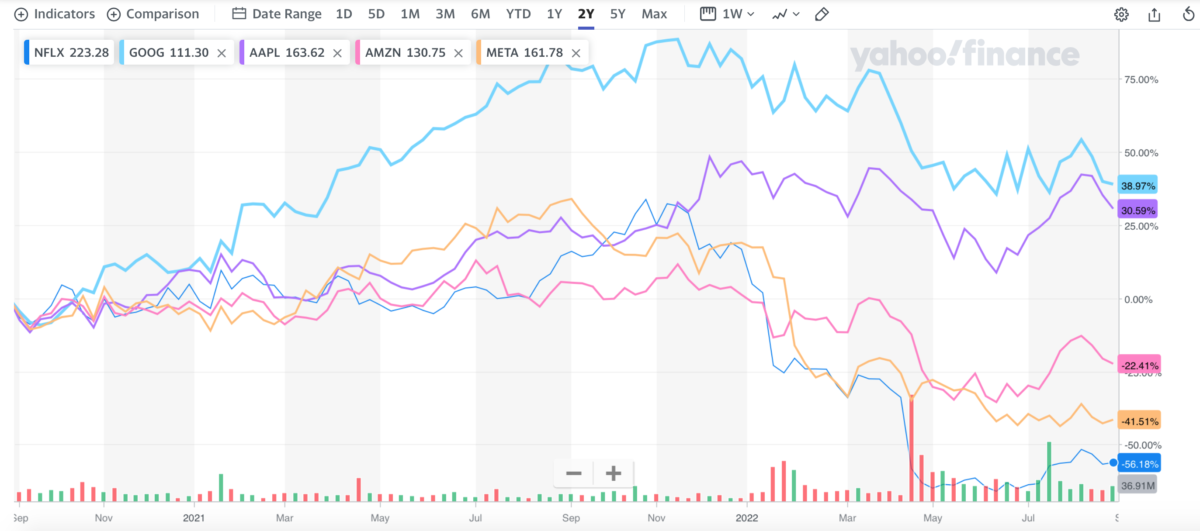
Second, Netflix is not really a tech stock. It is actually considered an entertainment company in the communications services sector. Plus, many investors no longer consider it a growth stock if you look at the return over the last few years.

Just in the last twelve months, Netflix has dropped over 61%. If you had bought the stock at the beginning of 2018 and held it, you would have barely broken even. If you had bought in in 2019, 2020, or 2021, and held it, you would have a good size loss.

Finally, even though Google changed its name to Alphabet, nobody calls it that, and the company is still keeping the same stock ticker symbols beginning with the letter G.

So that gives us Meta, Amazon, Google, and Apple as the leading tech stocks.

Or to abbreviate it, MAGA.

Now that should be easy to remember.

Disclosure: Author owns MSFT, AAPL and AMZN.

MORE POPULAR STOCK LISTS OF INTEREST

Top 10 Short Squeeze Plays

Stocks Going Ex Dividend

Business Development Companies Paying Over 10%